VERY High Temperature Hydrothermal Record in Plagioclase of BLACK Gabbros in Oman Ophiolite
Abstract:
In addition to major elements analyses, the crystallographic relationships of these Mg silicate inclusions to their host plagioclase are explored by Electron Back Scattering Diffraction (EBSD) processing.
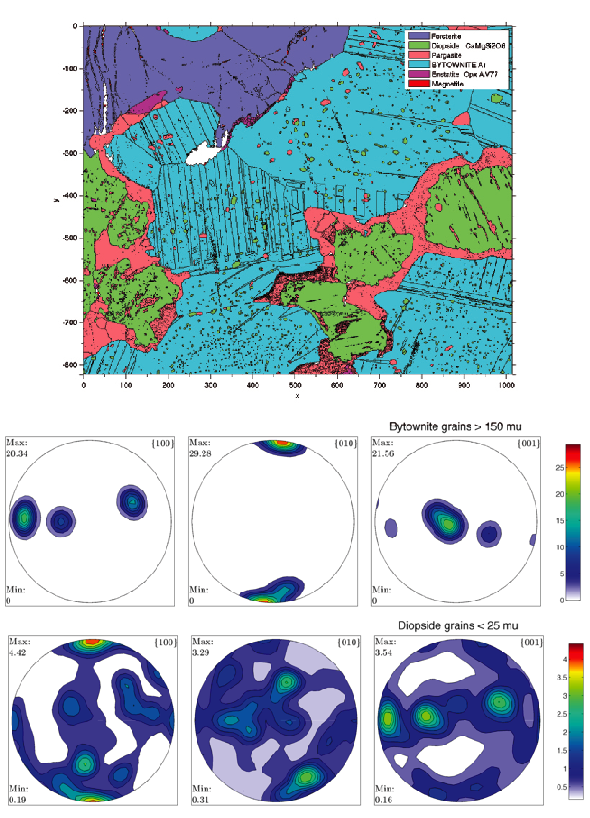
- Diopsidic clinopyroxene inclusions are dominant over pargasitic amphibole that tend to locate close to the margins of host plagioclase (Fig 1). Some inclusions are mixed clinopyroxene-amphibole, separated by a non-indexed phase that could represent a pyribole-type structure, suggesting transformation from clinopyroxene to amphibole during cooling. High chlorine content in the amphibole sign the seawater contamination at least during the development of this phase.
- Preliminary statistical pole figures (Fig. 2) in the six joined plagioclase grains studied, show that both plagioclase and diopside inclusions have a strong crystal preferred orientation (CPO) connected such that the strong [010]pl maximum coincide with the strong [100]di. In addition, a coincidence appears between three sub-maxima of [100]pl and [001]di. These interesting relationships are refined. It is inferred that clinopyroxene developed through corrosion of the plagioclase by a Mg-bearing hydrous fluid, penetrating possibly via twin interface and diffusing at T~1100°C, upper limit of clinopyroxene stability in hydrous conditions. Development of pargasite implies increasing hydration during cooling.