Controls for ecosystem methane exchange are time-scale specifc and shift during the growing season of a temperate fen
Abstract:
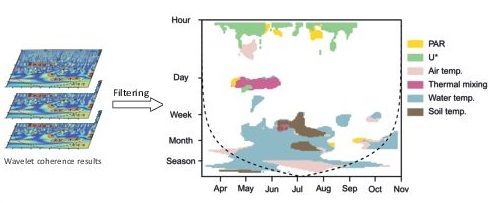
On large time scales of two weeks to three months, temperature explained most of the variation in ecosystem CH4 exchange. In general, the temperature in the shallow water column had the largest impact as explanatory variable, however, air temperature and soil temperature became increasingly important as explanatory variables when water level dropped slightly up to June. The diurnal variation of ecosystem CH4 exchange shifted during the course of the growing season: During a short time period at the end of April, plant activity (expressed by canopy photosynthesis) caused a diurnal variation of ecosystem CH4 exchange with peak time around noon. In the following weeks, the daily cycle of convective mixing within the water column (expressed by the water temperature gradient) gradually gained importance and caused high night-time CH4 emissions, thereby levelling off the diurnal CH4 emission pattern. Moreover, shear-induced turbulence caused short-term fluctuations of ecosystem CH4 exchange on time scales up to two hours.
Our study highlights the need for multi-scale approaches that consider the non-stationarity of the underlying processes to adequately describe the complexity of ecosystem CH4 exchange. Moreover, we show that CH4 release processes such as convective mixing of the water column which have been mainly considered for aquatic ecosystems might also be of importance in shallowly flooded terrestrial ecosystems.