Nitrous oxide production pathways in a partial nitritation-anammox reactor: Isotopic evidence for nitrous oxide production associated anaerobic ammonium oxidation?
Abstract:
Table 1. Summary of experiments conducted to understand N2O emissions
Experimental conditions |
O2 [mgO2/L] |
NO2- [mgN/L] |
NH4+ [mgN/L] |
N2O/NH4+ [%] |
Normal operation |
<0.1 |
<0.5 |
10 |
0.6 |
Normal operation, high NH4+ |
<0.1 |
<0.5 |
100 |
6.1 |
High aeration |
0.5 to 1.5 |
up to 50 |
10 and 50 |
4.9 |
NO2- addition (oxic) |
<0.1 |
<0.5 to 4 |
10 |
5.8 |
NO2- addition (anoxic) |
0 |
<0.5 to 4 |
10 |
3.2 |
NH2OH addition |
<0.1 |
<0.5 |
10 |
2.5 |
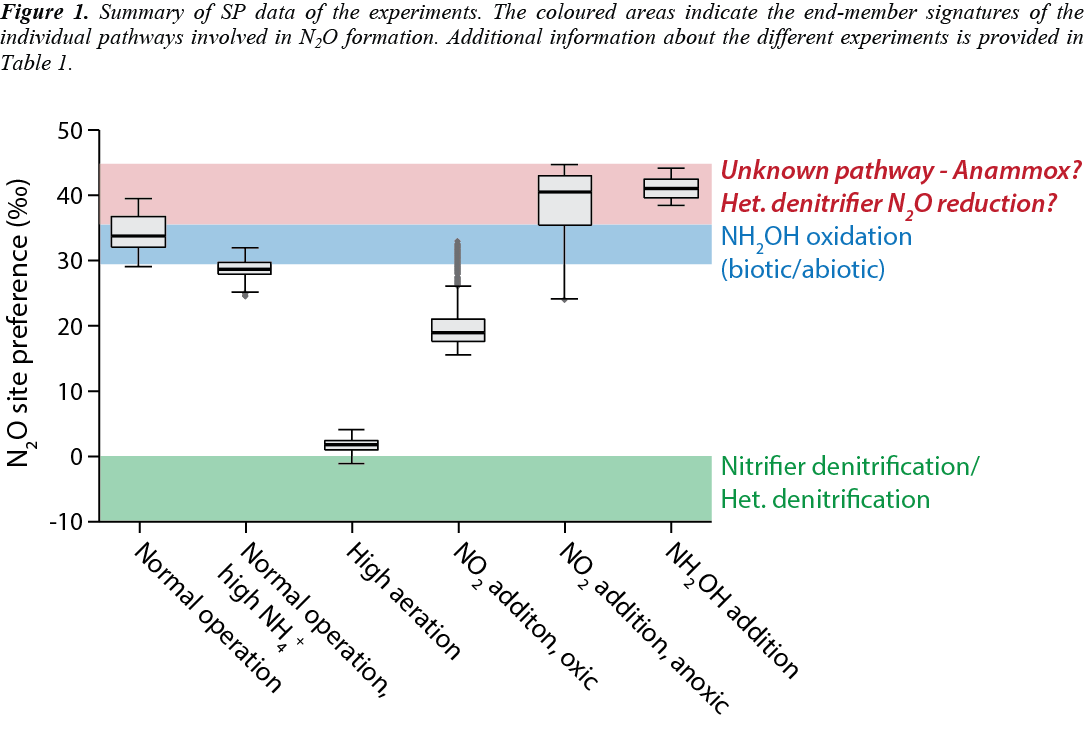
Results showed that under normal operating conditions, the N2O isotopic site preference (SP = d15Nα - d15Nβ) was much higher than expected - up to 41‰ – strongly suggesting an unknown N2O production pathway, which is hypothesized to be mediated by anammox activity (Figure 1). A less likely explanation is that the SP of N2O was increased by partial N2O reduction by heterotrophic denitrification. Various experiments were conducted to further investigate N2O formation pathways in the reactor. Our data reveal that N2O emissions increased when reactor operation was not ideal, for example when dissolved oxygen was too high (Table 1). SP measurements confirmed that these N2O peaks were due to enhanced nitrifier denitrification, generally related to nitrite build-up in the reactor (Figure 1; Table 1). Overall, process control via online N2O monitoring was confirmed to be an ideal method to detect imbalances in reactor operation and regulate aeration, to ensure optimal reactor conditions and minimise N2O emissions.
References
Waechter H. et al. (2008) Optics Express, 16: 9239-9244.
Wunderlin, P et al. (2013) Environmental Science & Technology 47: 1339-1348.