First-principles Simulations and the Criticality of Calving Glaciers
Jan Anders Åström1, Dorothee Vallot2, Martina Schäfer3, Ethan Welty4, Shad O'Neel5, Timothy C Bartholomaus6, Yan Liu7, Timo Riikilä8, Thomas Zwinger9, J. Timonen8 and John C Moore2,3, (1)CSC: IT Center for Science, Espoo, Finland, (2)Uppsala University, Department of Earth Science, Uppsala, Sweden, (3)University of Lapland, Rovaniemi, Finland, (4)University of Colorado at Boulder, Institute of Arctic and Alpine Research, Boulder, CO, United States, (5)USGS Alaska Science Center, Anchorage, AK, United States, (6)University of Idaho, Moscow, ID, United States, (7)Beijing normal university, Beijng, China, (8)University of JyväSkylä, JyväSkylä, Finland, (9)CSC - IT Center for Science, Espoo, Finland
Abstract:
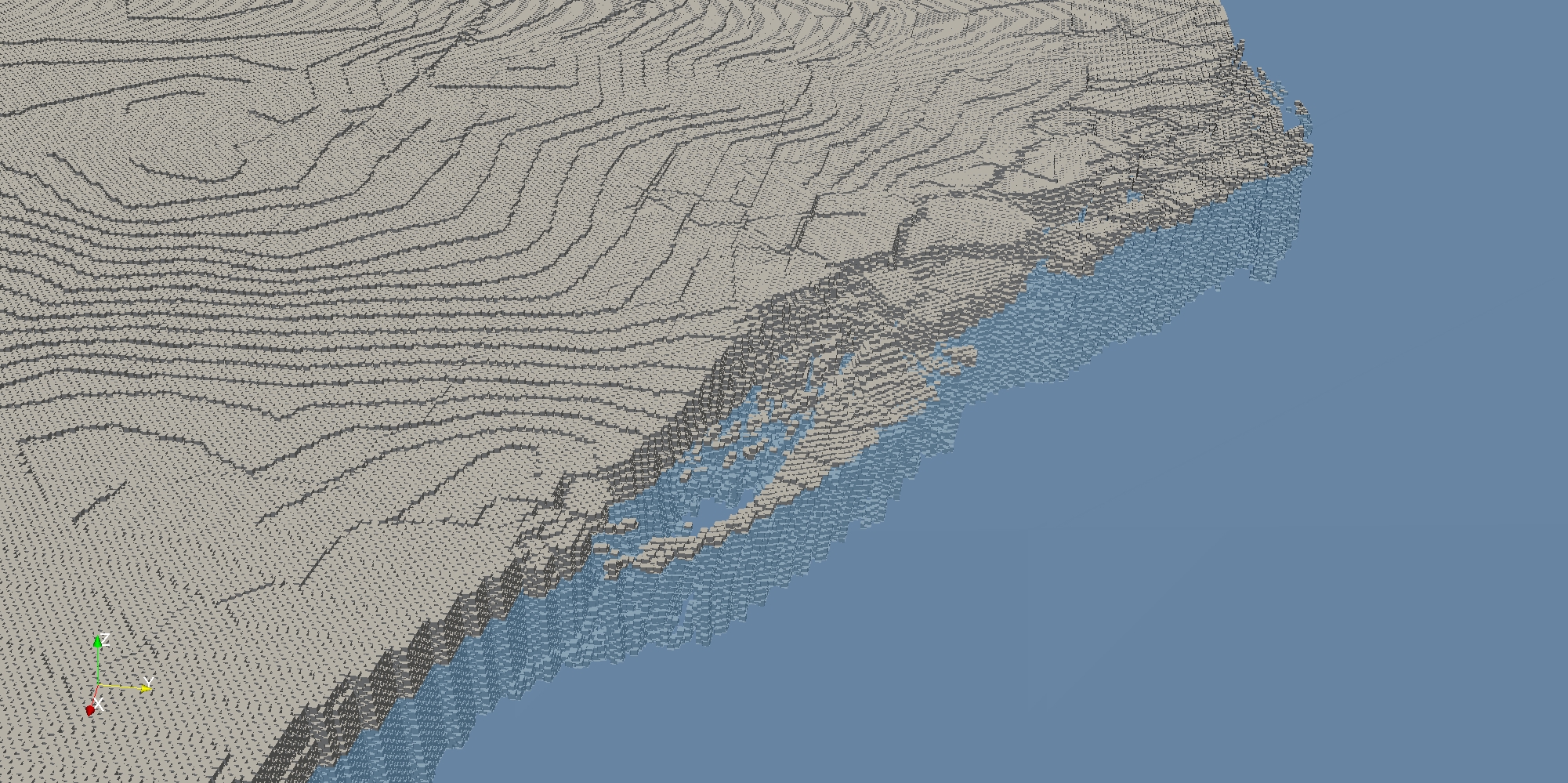
The algoritm of a first principles calving-simulation computer-code is outlined and demonstrated. The code is particle-based and uses Newtonian dynamics to simulate ice-fracture, motion and calving. The code can simulate real-size glacier but is only able to simualte individual calving events within a few tens of minutes in duration. The code couples to the Elmer/Ice ice flow-simulation code: Elmer is employed to produce various glacier geomteries, which are then tested for stability using the particle code. In this way it is possible to pin-point the location of calving fronts.
The particle simulation code and field observations are engaged to investigate the criticality of calving glaciers. The calving mass and inter-event waiting times both have power-law distributions with the same critical exponents as found for Abelian sand-pile models. This indicate that calving glaciers share characteristics with Self-Organized Critical systems (SOC). This would explain why many glacier found in nature may become unstable as a result of even minor changes in their environment. An SOC calving glacier at the critical point will display so large fluctuations in calving rate that it will render the concept 'average calving rate' more or less useless. I.e. 'average calving rate' will depend on measurement time and always have fluctuaions in the range of 100% more or less independent of the averaging time.