A Mobile Asteroid Surface Scout (MASCOT) for the Hayabusa 2 Mission to 1999 JU3: The Scientific Approach
A Mobile Asteroid Surface Scout (MASCOT) for the Hayabusa 2 Mission to 1999 JU3: The Scientific Approach
Abstract:
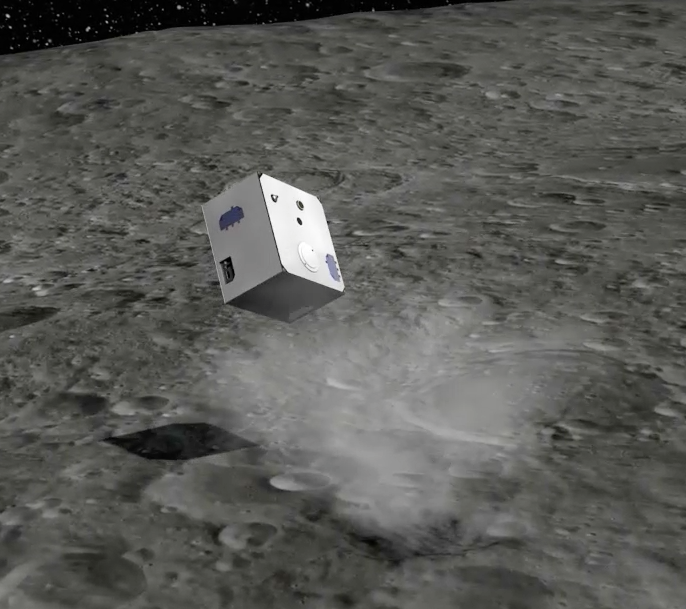
MASCOT, a Mobile Asteroid Surface Scout, will support JAXA’s Hayabusa 2 mission to investigate the C-type asteroid 1999 JU3 (1). The German Aerospace Center (DLR) develops MASCOT with contributions from CNES (France) (2,3). Main objective is to in-situ map the asteroid’s geomorphology, the intimate structure, texture and composition of the regolith (dust, soil and rocks), and the thermal, mechanical, and magnetic properties of the surface in order to provide ground truth for the orbiter remote measurements, support the selection of sampling sites, and provide context information for the returned samples. MASCOT comprises a payload of four scientific instruments: camera, radiometer, magnetometer and hyperspectral microscope. C- and D-type asteroids hold clues to the origin of the solar system, the formation of planets, the origins of water and life on Earth, the protection of Earth from impacts, and resources for future human exploration. C- and D-types are dark and difficult to study from Earth, and have only been glimpsed by spacecraft. While results from recent missions (e.g., Hayabusa, NEAR (4, 5, 6)) have dramatically increased our understanding of asteroids, important questions remain. For example, characterizing the properties of asteroid regolith in-situ would deliver important ground truth for further understanding telescopic and orbital observations and samples of such asteroids. MASCOT will descend and land on the asteroid and will change its position two times by hopping. This enables measurements during descent, at the landing and hopping positions #1-3, and during hopping.
Hayabusa 2 together with Mascot will launch beginning of December 2014, arrive at 1999JU3 in 2018 and return samples back to Earth in 2020.
References: (1) Vilas, F., Astronomical J. 1101-1105, 2008; (2) Ulamec, S., et al., Acta Astronautica, Vol. 93, pp. 460-466; (3) Jaumann et al., 45th LPSC, Houston; (4) Special Issue, Science, Vol. 312 no. 5778, 2006; (5) Special Issue Science, Vol. 333 no. 6046, 2011. (6) Bell, L., Mitton, J-., Cambridge Univ. Press, 2002