Examining rhyolite lava flow dynamics through photo-based 3-D reconstructions of the 2011-2012 lava flow field at Cordón Caulle, Chile.
Abstract:
Viscosities ranged from 7.5 x10⁹ to 1.1 x10¹¹Pa s, allowing for uncertainties in slope, surface displacement and velocity. Temperatures were modeled using a 1D finite difference method; in concert with viscosities of flow units these values compared well with published non-Arrhenian viscosity models. Derived thermodynamic and force ratios confirmed flow characteristics inferred from the image analyses. SfM-MVS represents an effective method of quantifying and displaying variation in the flow field, indicating several parallels between rhyolite emplacement and that of low-silica lavas.
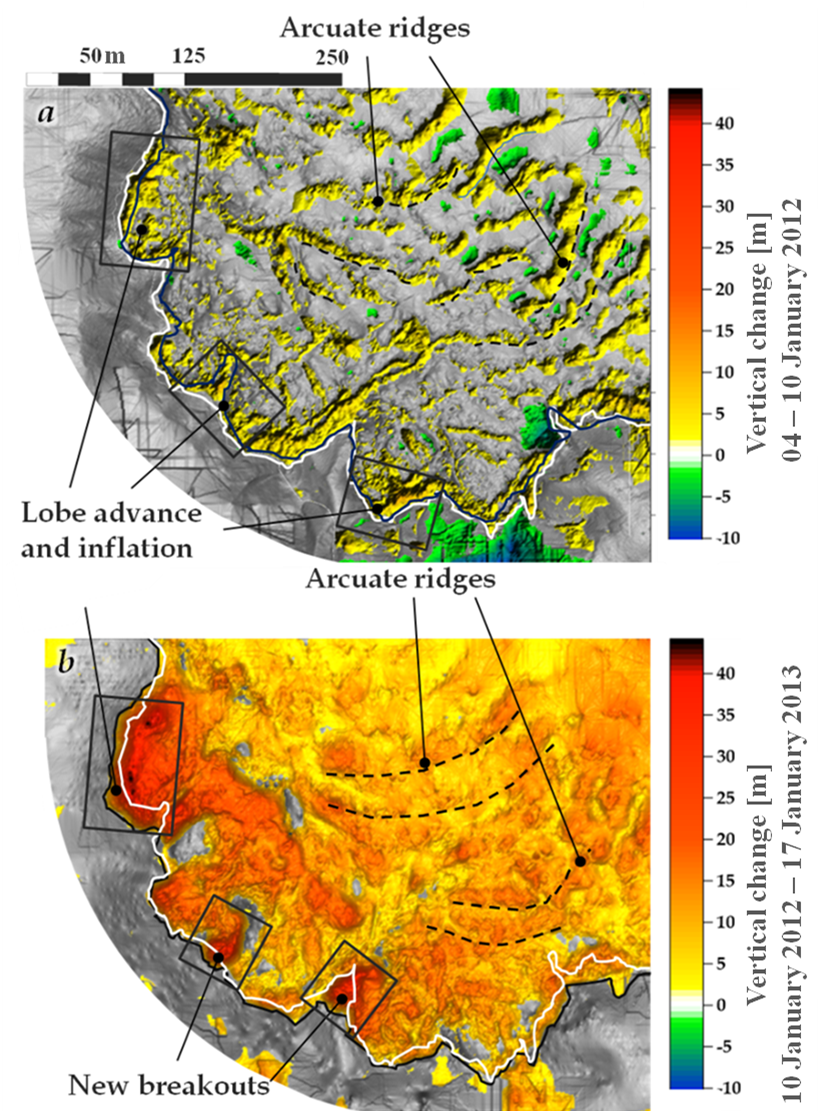
Initially channelised lava spread laterally and stagnated due to topography and the influence of the surface crust. Continued effusion resulted in iterative emplacement of breakout lobes, promoting lateral extension of the flow field. Insulation of the flow core by the viscous crust allowed this process to continue after effusion had ceased, creating features comparable to low-silica lavas, despite high viscosity and low effusion rates. This suggests that compound flow emplacement may be described by universal, cross-compositional models encompassing rheological differences of many orders of magnitude.
Tuffen et al. 2013, Nat. Comms., 4, 2709, doi:10.1038/ncomms3709