Lunar Proton Albedo Anomalies: Soil, Surveyors, and Statistics
Jody Keith Wilson, University of New Hampshire Main Campus, Space Science Center, Durham, United States, Nathan Schwadron, Los Alamos National Laboratory, Los Alamos, United States, Harlan E Spence, University of New Hampshire Main Campus, Durham, NH, United States, Anthony W Case, Smithsonian Astrophysical Observatory, Cambridge, MA, United States, Michael Joseph Golightly, Assurance Technology Corporation, Carlisle, MA, United States, Andrew Jordan, University of New Hampshire Main Campus, Space Science Center, Durham, NH, United States, Mark Dixon Looper, The Aerospace Corp, Los Angeles, United States, Noah E Petro, NASA GSFC, Greenbelt, United States, Mark Southwick Robinson, Arizona State University, School of Earth and Space Exploration, Tempe, United States, Timothy John Stubbs, NASA Goddard Space Flight Center, Greenbelt, MD, United States, Cary J Zeitlin, Southwest Research Institute, Oakland, CA, United States, J Bernard Blake, The Aerospace Corp, Los Angeles, CA, United States, Justin Christophe Kasper, University of Michigan, Climate and Space Sciences and Engineering, Ann Arbor, United States, Joseph E Mazur, The Aerospace Corporation, Chantilly, VA, United States, Sonya S Smith, University of New Hampshire, Durham, United States and Lawrence W Townsend, University of Tennessee Knoxville, Knoxville, TN, United States
Abstract:
Since the launch of LRO in 2009, the CRaTER instrument has been mapping albedo protons (~100 MeV) from the Moon. These protons are produced by nuclear spallation, a consequence of galactic cosmic ray (GCR) bombardment of the lunar regolith. Just as spalled neutrons and gamma rays reveal elemental abundances in the lunar regolith, albedo protons may be a complimentary method for mapping compositional variations.
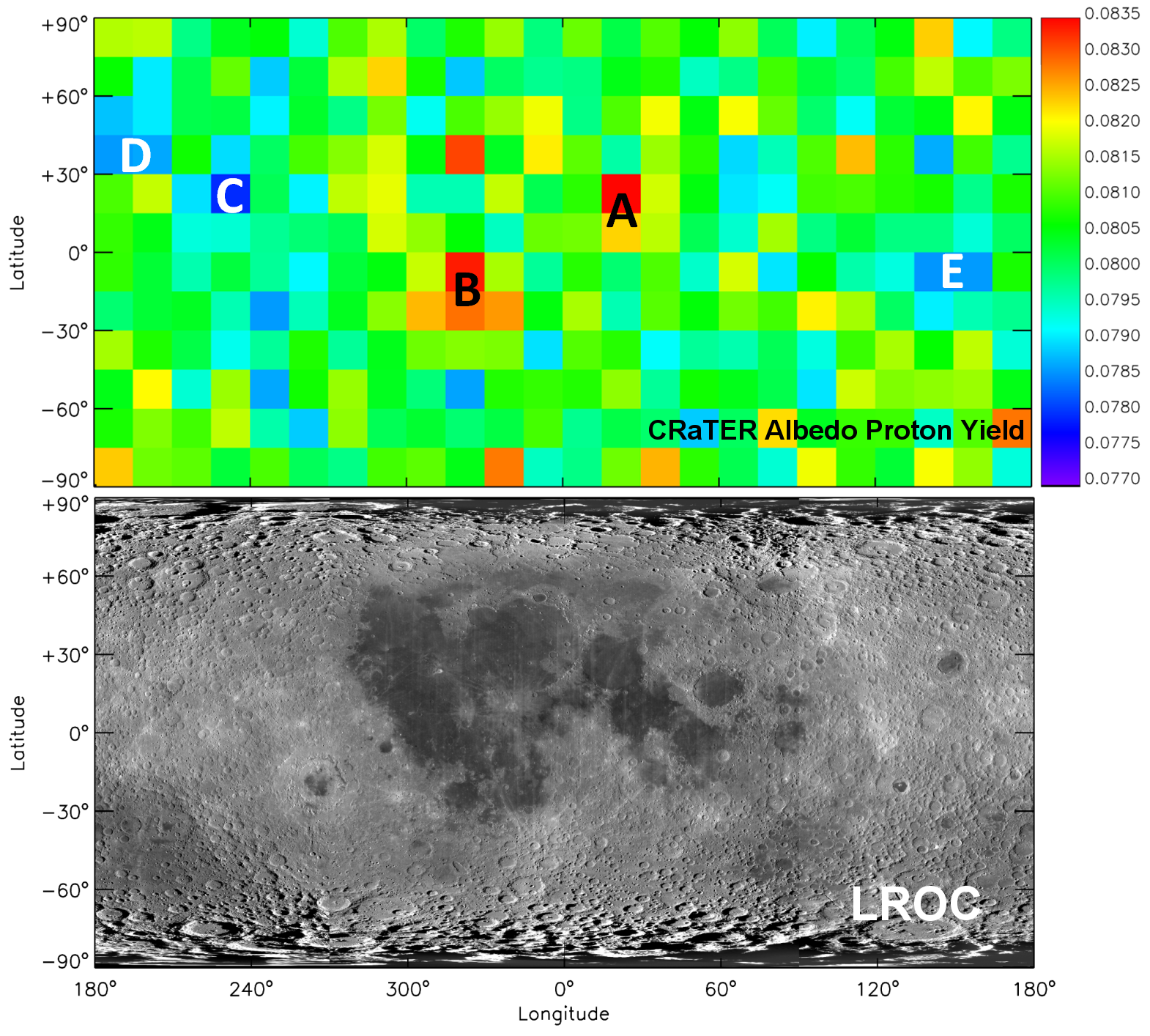
We presently find that the lunar maria have an average proton yield 0.9% ±0.3% higher than the average yield in the highlands; this is consistent with neutron data that is sensitive to the regolith’s average atomic weight.
We also see cases where two or more adjacent pixels (15° × 15°) have significantly anomalous yields above or below the mean. These include two high-yielding regions in the maria, and three low-yielding regions in the far-side highlands. Some of the regions could be artifacts of Poisson noise, but for completeness we consider possible effects from compositional anomalies in the lunar regolith, including pyroclastic flows, antipodes of fresh craters, and so-called "red spots". We also consider man-made landers and crash sites that may have brought elements not normally found in the lunar regolith.