Glacier Basal Sliding in Two-Dimensions Quantified from Correlation of High-Resolution Satellite Imagery: A Case Study on Kennicott Glacier, Alaska
Abstract:
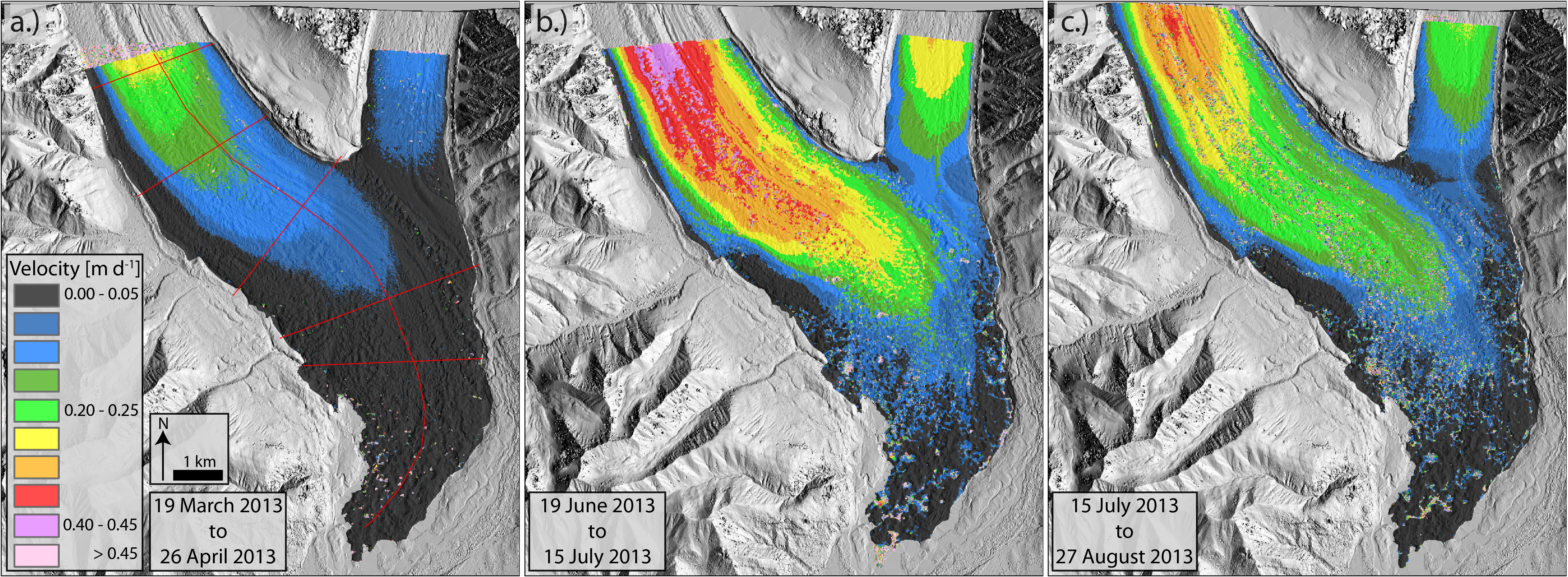
By assuming that spring (March-April) glacier velocity results solely from viscous deformation, we produce spatially distributed maps of glacier sliding speed by differencing summer and spring ice surface speeds. For a given time, a large portion of our study reach slides with roughly uniform speed, despite significant variation in deformation speed. This suggests that glacier flow models in which basal sliding is taken simply to scale as ice surface velocity are unfounded. The upglacier end of our study reach slides at speeds that vary through the summer, whereas the terminal reach slides at a steady speed. The proportion of glacier motion due to sliding increases dramatically moving downglacier, making basal sliding especially important in the terminal region.
Many formulations express glacier sliding as a function of effective pressure (ice pressure minus water pressure). If such formulations are correct, effective pressure varies little over large areas or is averaged over lengthscales equivalent to ~10 glacier thicknesses. Also, effective pressure is steady in the terminal region through the summer. We explore existing sliding laws to find which best describes the observed spatiotemporal pattern of sliding.