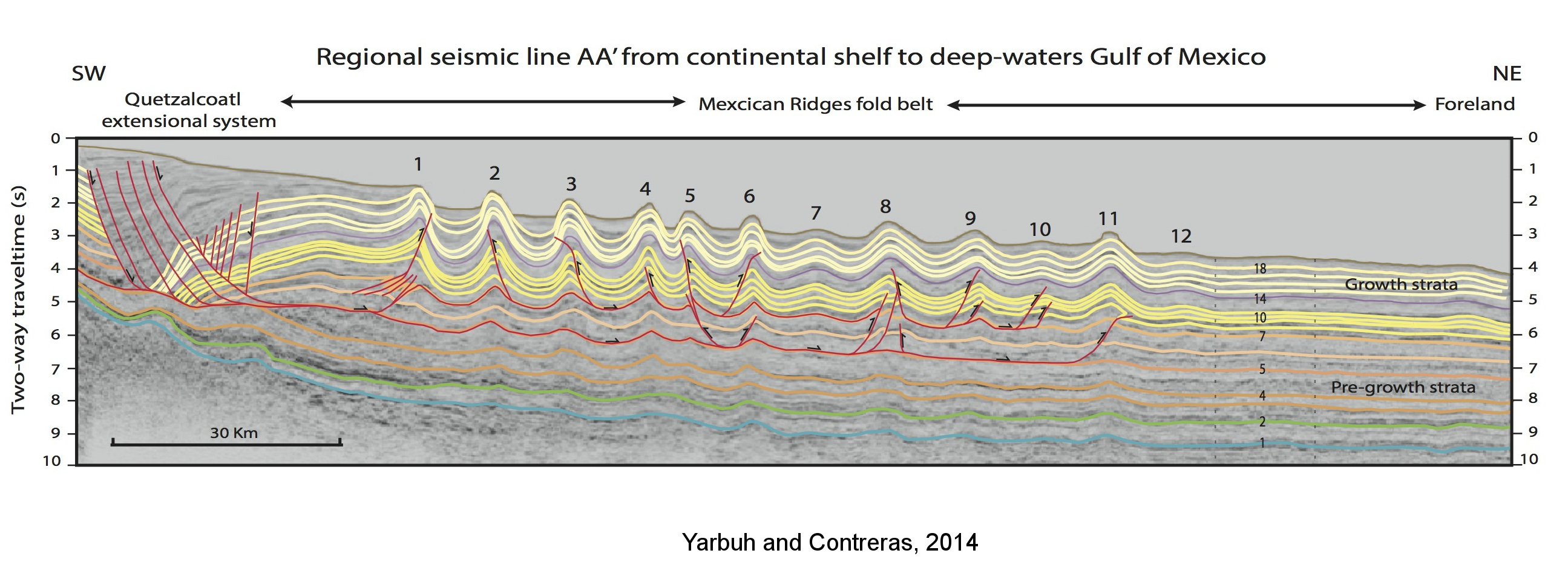
The Mexican Ridges Fold Belt, Gulf of Mexico: Deformation, Dynamics of Deposition of Growth Strata, and the Delay of Sedimentary Response to Tectonic Forcing
Abstract:
Results show tectonic transport in the MRFB is 11.8 km; shortening of individual folds ranges 3-16%, with an average strain for the entire MRFB of ~10%; structures grew at a mean uplift rate of 0.2 mm/yr. We estimate the constant of mass diffusivity, which controls the rate of degradation, has a mean value of 0.27 m2/yr. This value is characteristic of rapid, episodic mass movements. Finally, the sedimentation rate is ~0.2 mm/yr. Those parameters, however, are not constant; they decrease toward the deepwater portion of the fold belt. The structures proximal to the continental shelf are rising rapidly and are being degraded more intensely than those in the distal part of the fold belt.
Our results reveal that deformation started synchronously throughout the MRFB during the Late Miocene and not in two episodes as previously reported. The reason for the seeming discrepancy is due to the copious sedimentation in the eastern section of the fold belt with respect to tectonic uplift. This hindered the development of onlap and thinning upward patterns that commonly signal the beginning of fold growth. The delay, in turn, introduces a bias toward younger ages in the identification of the pre-growth/growth strata limit.