Tectonoestratigraphic and Thermal Models of the Tiburon and Wagner Basins, northern Gulf of California Rift System
Abstract:
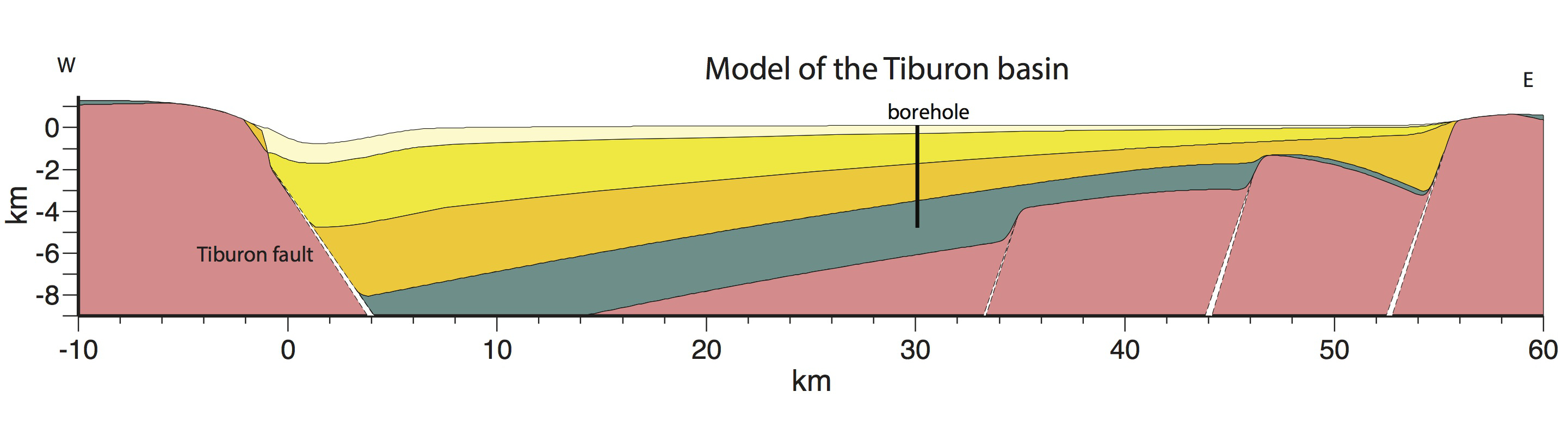
Analysis of the seismic lines and models’ results show that: (i) subsidence of the basins is controlled by high-angle normal faults and by flow of the lower crust, (ii) basins share a common history, and (iii) there are significant differences in the way brittle strain was partitioned in the basins, a feature frequently observed in rift basins. On one hand, the bounding faults of the Tiburón basin have a nested geometry and became active following a west-to-east sequence of activation. The Tiburon half-graben was formed by two pulses of fault activity. One took place during the protogulf extensional phase in the Miocene and the other during the opening of Gulf of California in the Pleistocene. On the other hand, the Wagner basin is the result of two fault generations. During the late-to middle Miocene, the west-dipping Cerro Prieto and San Felipe faults formed a domino array. Then, during the Pleistocene the Consag and Wagner faults dissected the hanging-wall of the Cerro Prieto fault forming the modern Wagner basin.
Thermal modeling of the deep borehole temperatures suggests that the heat flow in these basins in the order of 110 mW/m2 which is in agreement with superficial heat flow measurements in the northern Gulf of California Rift System.