Experiments with Low Voltage Field Emission EPMA
Abstract:
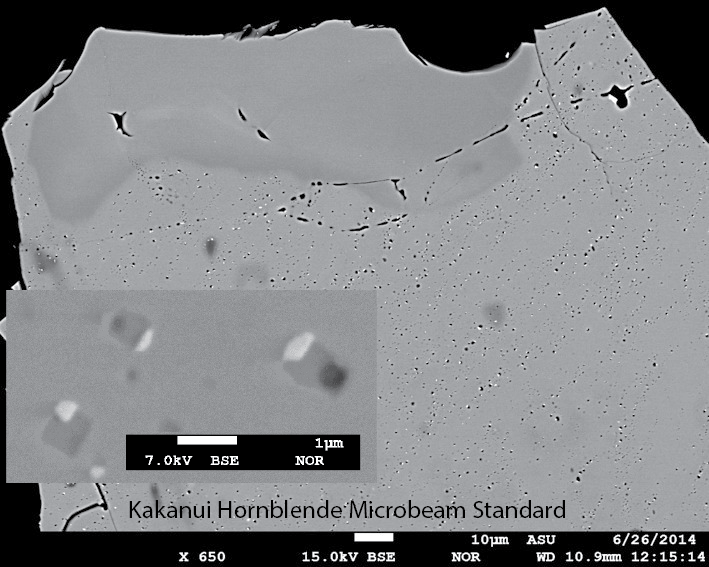
The enhanced resolution of FE-EPMA reveals problems with some microanalytical standards. Vicenzi and Rose (2008) showed submicron inclusions in the Smithsonian Kakanui hornblende standard. Our 7 keV experiments show the ~400 nm inclusions consist of a silicate phase (glass?), Fe-Ti oxide and possibly a gas bubble, concentrated along planes or grain boundaries. SEM imaging of an inclusion analyzed with a focused FE beam shows radiating trails of debris on the hornblende host, consistent with residue from a popped vapor bubble in the inclusion. How should FE-EPMA handle standards that may have inclusions? Use a focused beam avoiding inclusions? Sometimes, perhaps. However, we used a defocused beam to "average" the phases. The results show little or no deviation from the published wet chemical analysis.
Operation at reduced keV may require use of non-traditional X-ray lines (e.g. Gopon et al, 2013 for Fe Ll vs Fe La). Experiments at 5 keV were also performed upon a synthetic material enriched in Nd (Nd-Mg-Zn). Fischer & Baun (1967) demonstrated problems with the Ma/Mb lines of REE; we find that use of the Nd Mz line is necessary in order to achieve reasonable results in this material (98 wt% total, Nd 36 wt% vs 126 wt% total, Nd 67 wt% with Mb line). We also report on 7 and 15 keV time dependent intensity variations in Ir-coated calcite and dolomite and on the lack of interfering lines with 6 Å Ir.