Bayesian estimation of moment tensors and slip history based on prior knowledge from deterministic source inversion
Bayesian estimation of moment tensors and slip history based on prior knowledge from deterministic source inversion
Abstract:
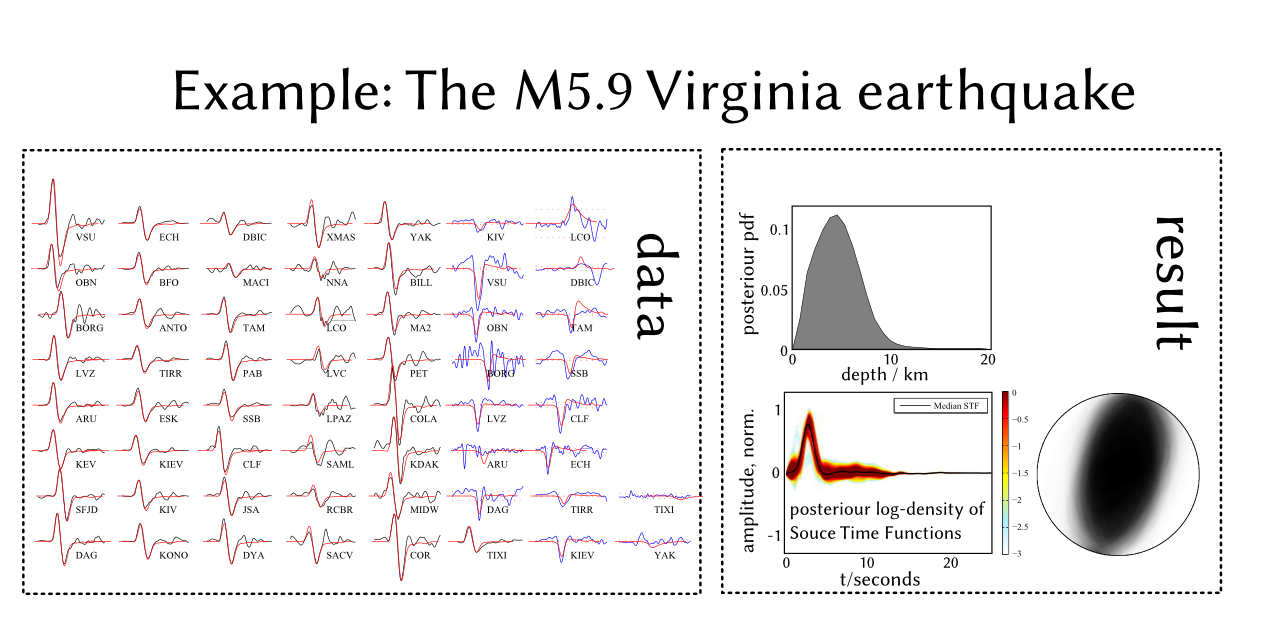
Determination of point source solutions is a necessity for numerous applications in seismology (e.g., waveform tomography), as well as applications where the focal mechanisms and locations of earthquakes are used to infer tectonic models. We present a probabilistic framework for inversion of depth, moment tensor and moment rate (source time function) from teleseismic P and SH waveforms. The results are to be compiled into a global Bayesian earthquake catalogue.
Bayesian inference from waveforms crucially depends on the noise model. Since we consider the assumption of sample-wise normally distributed noise unrealistic, we opt for a waveform misfit criterion. In order to establish its statistical properties in the presence of noise and realistic modelling errors, we harness a database of 1800 deterministic source solutions to derive the parameters of the Likelihood function needed in Bayesian inference.
The inversion scheme itself uses the Neighbourhood Algorithm to infer a statistical ensemble of source solutions. These can for example be used to infer the influence of source uncertainty on the input parameters for seismic waveform tomography, such as cross-correlation traveltimes.