Impact of wind on the dynamics of explosive volcanic plumes inferred from analog experiments
Impact of wind on the dynamics of explosive volcanic plumes inferred from analog experiments
Abstract:
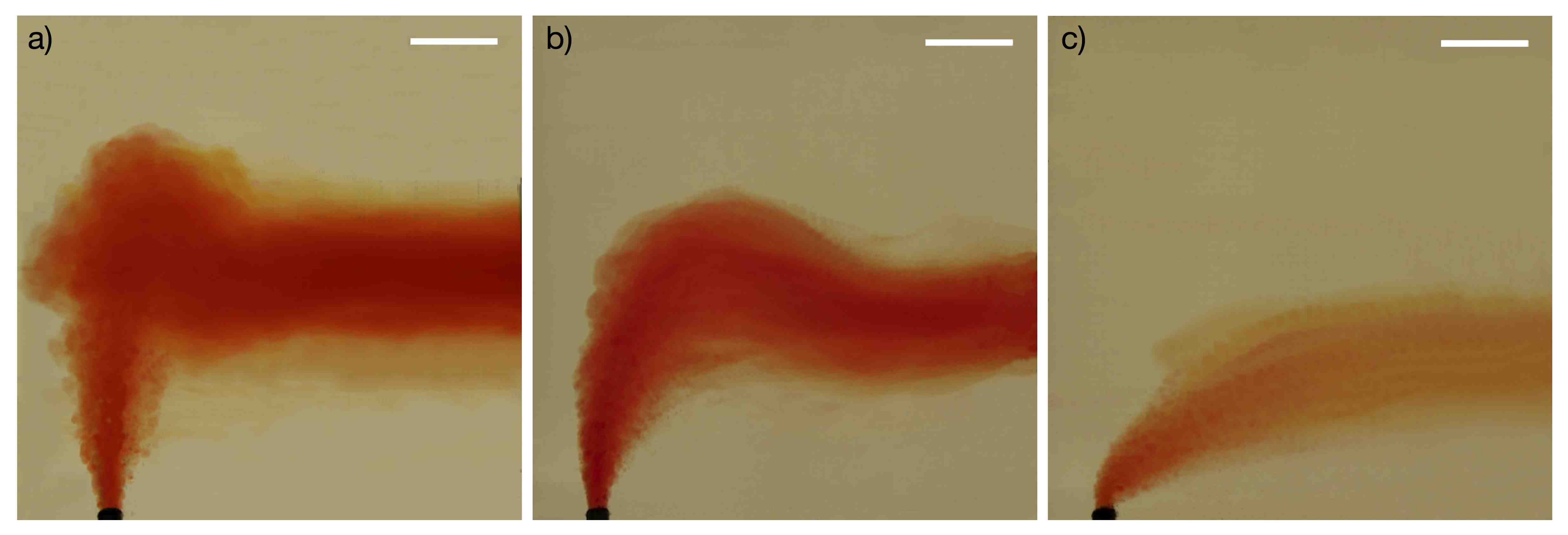
Volcanic plumes produced by explosive eruptions commonly interact with atmospheric wind causing plume bending and a reduction of its maximum height. Strength of the wind field and intensity of the eruption control the behavior of the column in the atmosphere, which may form either a strong plume that is little affected by the presence of wind or a weak plume that is bent-over in the wind field. To better understand the transition between weak and strong plumes, we present a series of new laboratory reproducing a buoyant jet rising in a stratified environment with a uniform cross-flow. The experiments consist in injecting downward fresh water in a tank containing an aqueous NaCl solution with linear density stratification. The jet source is towed at a constant speed through the stationary fluid in order to produce a cross-flow. We show that depending on the environmental and source conditions, the buoyant jet may form either a strong, distorted, or weak plume. The transition from one dynamical regime to another is governed by the strength of the horizontal wind velocity compared to the vertical buoyant rise of the plume. A review of field data on historical eruptions confirms that the experimentally-determined transition curves capture the behavior of volcanic columns. We quantify the impact of wind on the maximum height reached by the column, and we propose a universal scaling relationship to link the mass discharge rate feeding an eruption to its observed maximum height in the presence of wind.