How Large are Heat Flow Variations across Mars' Surface?
Abstract:
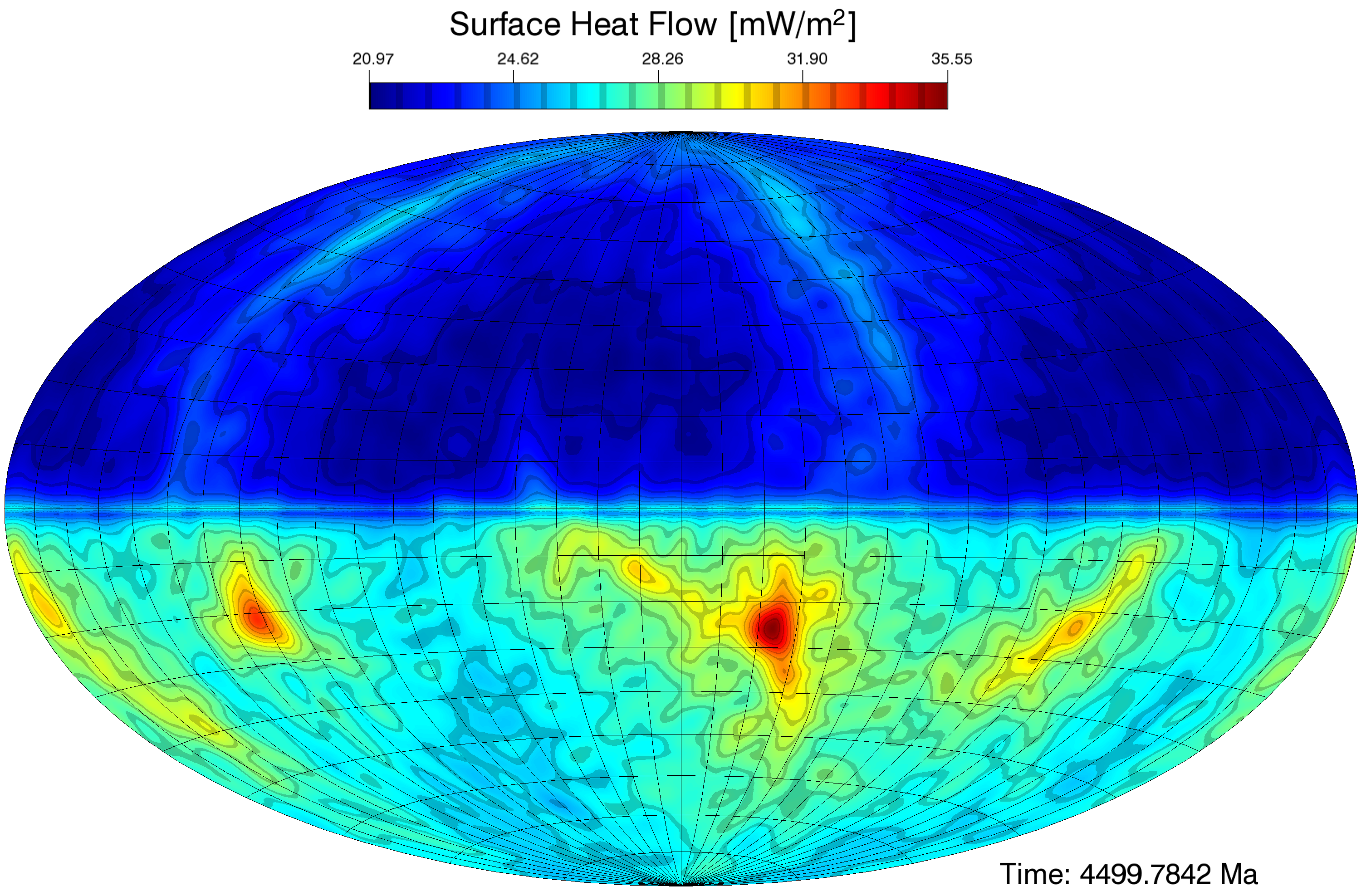
We have tested this assumption by running thermal evolution models for Mars in 3D spherical geometry [3]. In our calculations, we use a crust of fixed thickness with a north-south dichotomy in crustal thickness, a low conductivity compared to the mantle and enriched in radiogenic heat producing elements. Our results show that including compressibility effects, phase transitions and different core sizes, surface heat flow variations are mainly dominated by the crust contribution, unless the mantle viscosity increases more than three orders of magnitude with depth. In the latter case, heat flow variations due to mantle upwellings are ~8 mW/m2relative to surface average and remain confined to limited surface regions (Fig. 1). Further, we use constraints from elastic thickness estimates [4] and geoid [5] to choose a best-fit model for the present-day Martian mantle. Both surface heat flow variations on Mars obtained from numerical models and the heat flow measurement planned for the InSight mission will permit to address the question of a possible plume underneath Elysium and also to test the feasibility of present-day volcanism on Mars.
[1] Hahn et al., GRL, 2011; [2] Kiefer & Li, GRL, 2009; [3] Hüttig & Stemmer, PEPI, 2008; [4] Phillips et al., Science, 2008; [5] Wieczorek & Zuber, JGR, 2004.
Fig. 1 Surface heat flow variations after 4.5 Ga of thermal evolution.