Contribution of foraminifera to discriminate depositional events within an apparently massive tsunami deposit
Abstract:
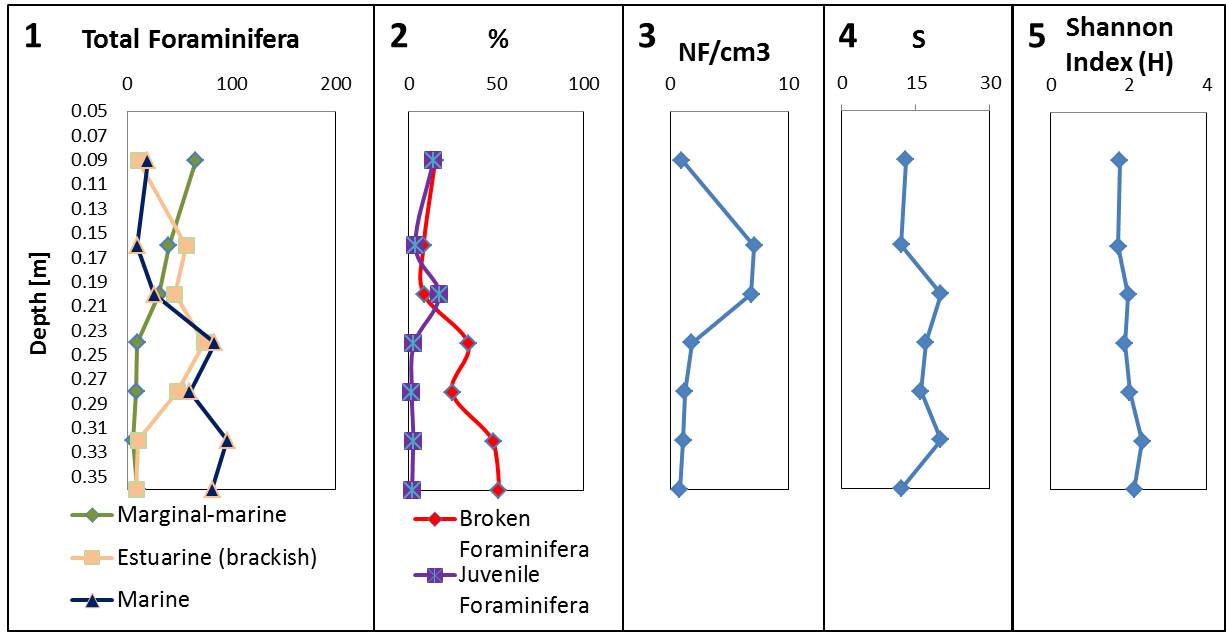
The foraminiferal species were grouped in marine (infratidal/inner shelf + planktic), marginal-marine (low estuary/lagoon) and estuarine (brackish middle estuary) assemblages after Murray (2006) (Image 1). Present-day analogues were also studied. Broken (corroded included) and juvenile tests (Image 2) were counted and density (NF/cm3) (Image 3), species richness (S) (Image 4) and diversity (H(s)) (Image 5), calculated.
The preliminary results indicate 3 zones:
A - base of the deposit - dominance of a marine assemblage, the acme in broken tests content, highest S/H(s) and lowest NF/cm3;
B - a significant rise of estuarine group, as well as a drop of broken tests and S/H(s);
C - marine species and broken tests increase, estuarine group still relevant;
In the overlying unit it was observed: a drop in the marine group and slight increase in estuarine species and S/H(s); sharp rise in NF/cm3, marginal marine group and juveniles; the proportion of broken tests drops to a minimum.
Marginal-marine species dominate both the mud capping the deposit and the underlying unit.
The vertical variation in broken tests correlates with the marine taxa (R=0.97) throughout the deposit.
The zones were interpreted as the signal of multiple run-in and backwash during one event. A might represent the first incoming wave, carrying marine and diverse broken faunas eroded from the inner shelf; B might reflect tsunami reworking of the middle estuary, the backwash adding brackish species to the assemblage; C suggest another run-in episode, adding new marine species to a mixed assemblage.
These preliminary results stress the potential of foraminifera as a proxy in studies of inundation vs backwash tsunami sedimentation in coastal lowlands.