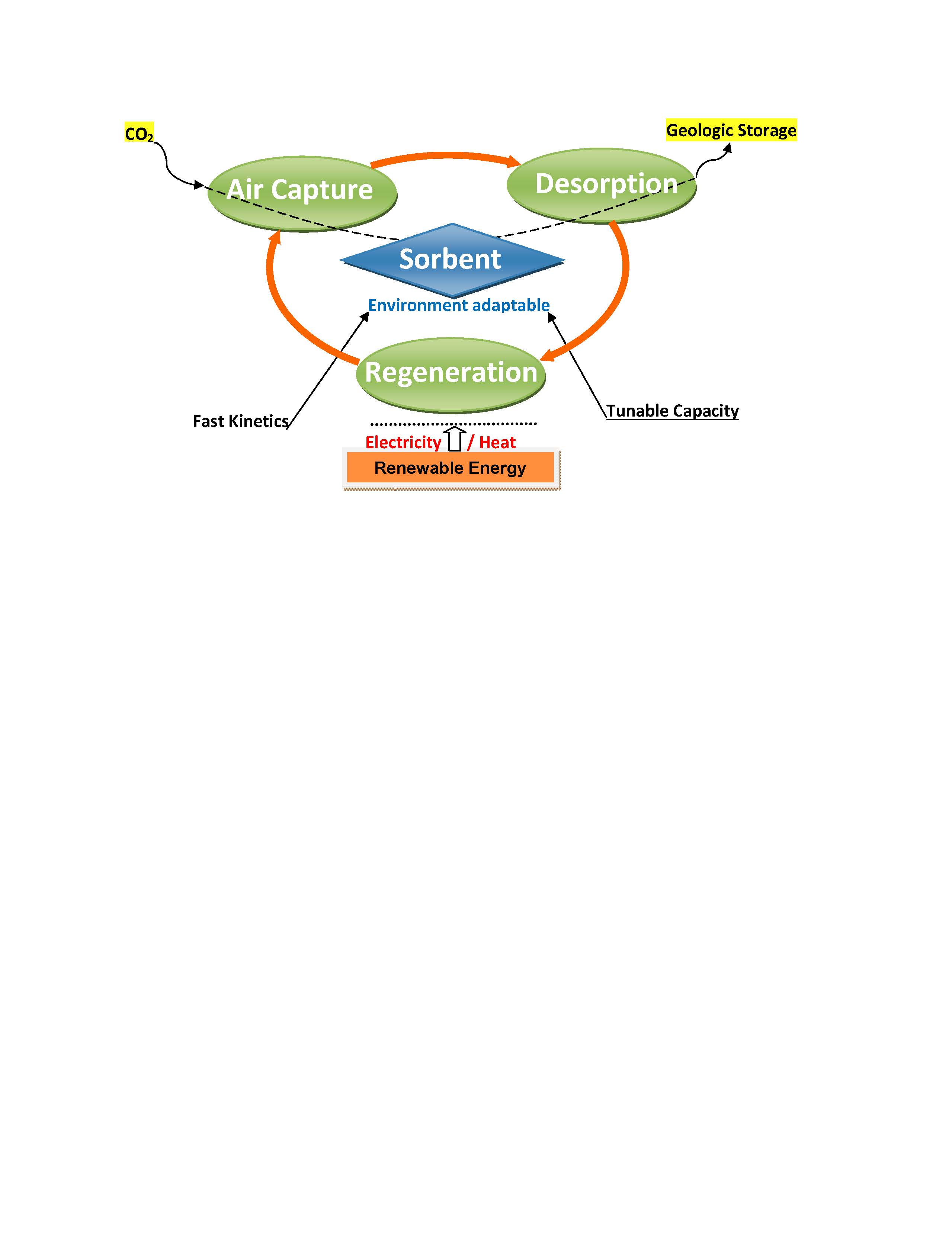
capture amount can be reduced by the poor thermodynamics and kinetics at high relative humidity or low temperature. Similar challenges also exist for thermal or vacuum swing sorbents. Developing sorbent materials which adapt to specific environments, such as high humidity or low temperature, can ensure sufficient capture capacity on the one hand, and realize better economics on the other hand (Figure 1) .An environment adaptive sorbent should have the abilities of tunable capacity and fast kinetics at extreme conditions, such as high humidity or low temperature. In this presentation, the possibility of tuning CO2 absorption capacity of a polymerized ionic liquid material is discussed. The energy requirement evaluation shows that tuning the CO2 binding energy of sorbent, rather than increasing the temperature or reducing the humidity of air, could be much more economic. By determining whether the absorption process is controlled by physical diffusion controlled or chemical reaction, an effective approach to fast kinetics at extreme conditions is proposed. A shrinking core model for mass transfer kinetics is modified to cope with the relatively poor kinetics of air capture. For the studied sample which has a heterogeneous structure, the kinetic analysis indicates a preference of sorbent particle size optimization, rather than support layer optimization. Chemical reaction kinetics could be enhanced by stronger binding energy or higher temperature. However, the total kinetics can only be significantly improved by chemical reaction enhancement if the physical diffusion is fast enough.