Finite Frequency Measurements of Conventional and Core-diffracted P-waves (P and Pdiff)
Abstract:
The actual, non-ray-like sensitivities have been difficult to model, as have been the associated synthetic seismograms. Core-diffracted waves have therefore not been used in tomography, despite abundant observations of these phases on modern broadband seismograms. Hence current global body-wave tomographies illuminate the lower third of the mantle much less well than the upper and especially the middle third.
This study aims for broadband, global waveform tomography that seamlessly incorporates core-diffracted phases alongside conventional, teleseismic waves as well as regional body-waves. Here, we investigate the properties of P-diffracted waves in terms of waveform characteristics and travel-time measurements as compared to teleseismic P-wave measured by the same methods.
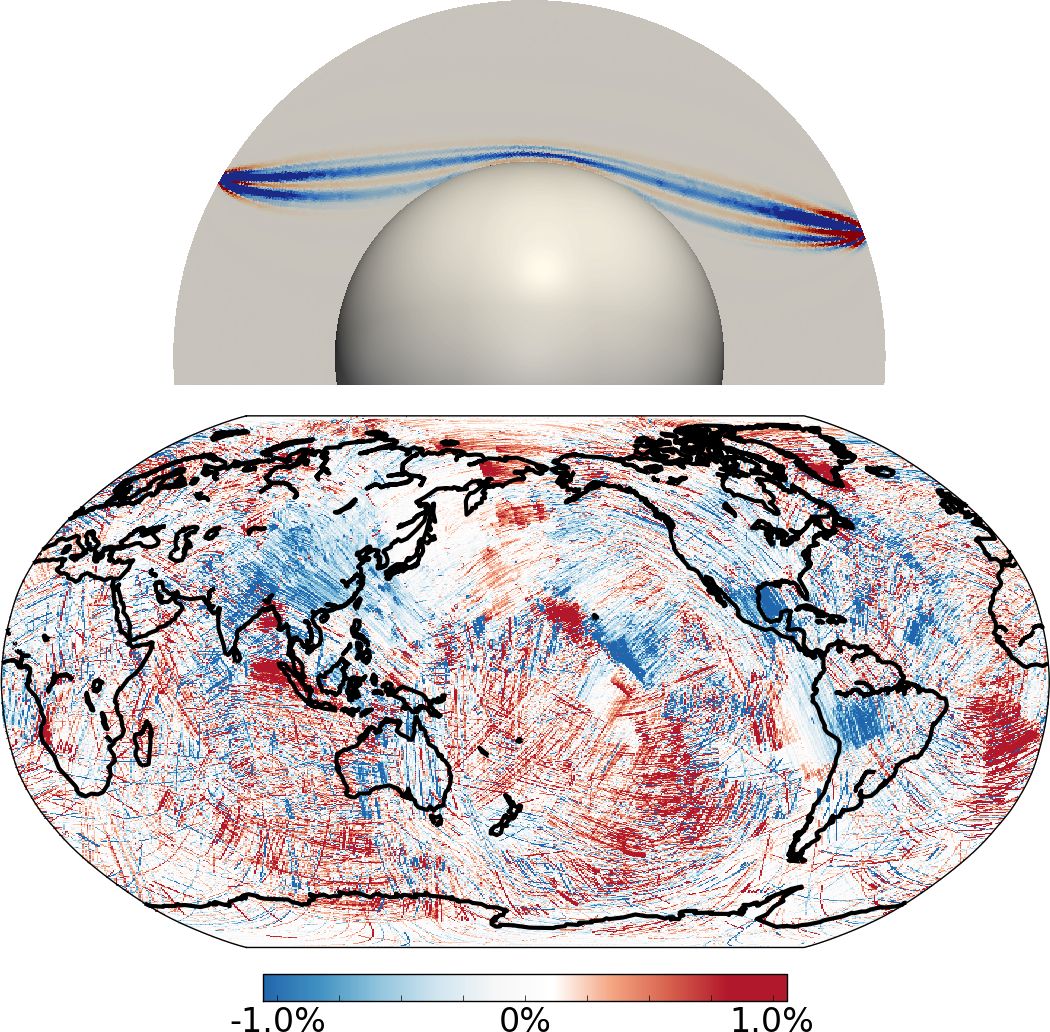
Travel time anomalies, the primary data for tomography, are measured by waveform cross-correlation of data with synthetics, where the synthetics are calculated from fully numerical wave propagation in a spherically symmetric background model. These same numerical tools will be used to calculate the associated sensitivity kernels for tomography (figure, top).
Demonstrating the extent to which waveform modeling can fit real data, we assemble and discuss a global data set of 851,905 Pdiff and 2,368,452 P-wave multi-frequency cross-correlation travel times. Findings are summarized in the Pdiff travel time map (figure, bottom) in which most major structures found in previous studies are detectable, plus several new velocity anomalies.