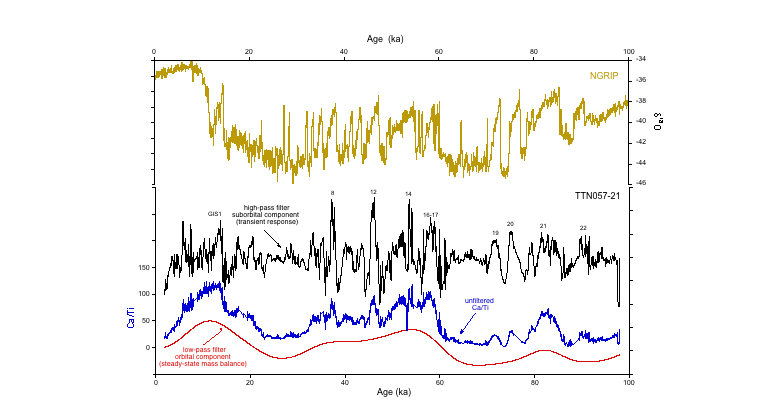
A 400-kyr record of millennial-scale carbonate preservation events in the Southern Ocean: Implications for Atlantic Meridional Overturning Circulation and atmospheric CO2
Abstract:
During the last glacial period, distinct millennial-scale increases in carbonate preservation in piston core TN057-21 occurred during times of enhanced Atlantic Meridional Overtunring Circulation (AMOC) (Barker et al., 2010; Barker and Diz, 2014), as supported by increases in benthic δ13C and less radiogenic εNd values. Carbonate preservation peaked particularly during long, warm interstadials in Greenland when a deep water mass with high carbonate ion concentration was formed in the North Atlantic. Export of NADW may have been greater than the Holocene during some of these events (“overshoots”) and/or preformed carbonate ion concentrations in North Atlantic source areas may have been higher owing to lower atmospheric CO2 and less carbonate production in surface water. Each South Atlantic carbonate peak is associated with the start of Antarctic cooling and declining or leveling of atmospheric CO2, reflecting the signature of a thermal bipolar seesaw. The increased flux of carbonate ion to the Southern Ocean during strong interstadials may have played a role in titrating respiratory CO2, thereby slowing CO2 degassing to the atmosphere and providing a secondary mechanism, in addition to heat transport, for interhemispheric coupling on millennial time scales.