Conjoint Seasonal and Intraseasonal Dynamics of Precipitation and NDVI Over The Amazon And The Congo Rainforests
Abstract:
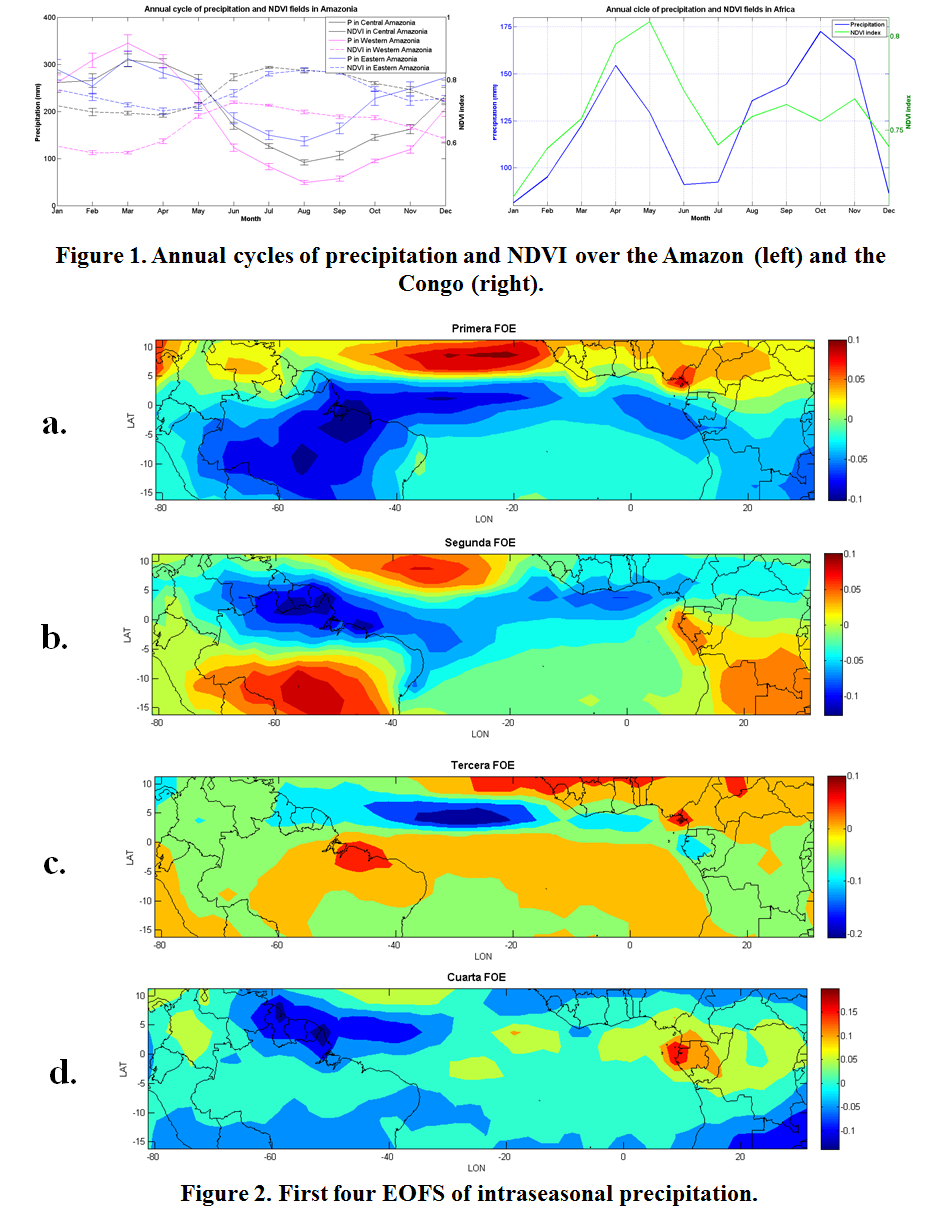
A (tropical) transatlantic Empirical Orthogonal Functions (EOF) analysis of pentad precipitation (20-100 day filtered) indicates that EOF No. 1 (52% of variance; Fig. 2a) exhibits a meridional dipole with higher positive loadings over the tropical North Atlantic (5°N-10°N), and higher negative loadings from 5°N to the equator over the Atlantic, and to 15°S over the continents. The Principal Component No. 1 exhibits a predominant 37-day frequency. EOF No. 2 (18% of variance; Fig.2b) exhibits a tripole pattern with positive loadings over southern Amazonia, the tropical North Atlantic, and (south) equatorial Africa, and a transatlantic pattern of negative loadings from 0 to 5°N including both continents, with a 38-day periodicity. EOF No. 3 (8% of variance; Fig. 2c) exhibits a tripole between the Amazon, the Atlantic Ocean and the Congo, with a 19-day frequency. EOF No. 4 (5%; Fig. 2d) shows a dipole between the Amazon and Congo rainforests, with a predominant period of 20 days. The apparent west-to-east patterns identified in the principal EOFs could be associated with the predominant movement of the intraseasonal Madden-Julian Oscillation (MJO) and Kelvin waves, whereas EOFs No. 3 and 4 denote modes associated to sub-monthly variability.