Mineral Carbonation Potential of CO2 from Natural and Industrial-based Alkalinity Sources
Abstract:
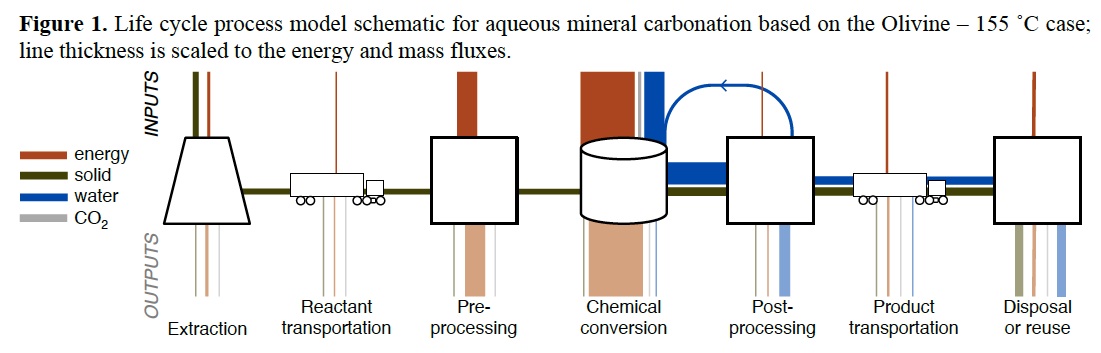
The life-cycle assessment of aqueous mineral carbonation suggests that a variety of alkalinity sources and process configurations are capable of net CO2 reductions. The maximum carbonation efficiency, defined as mass percent of CO2 mitigated per CO2 input, was 83% for CKD at ambient temperature and pressure conditions. In order of decreasing efficiency, the maximum carbonation efficiencies for the other alkalinity sources investigated were: olivine, 66%; SS, 64%; FA, 36%; and serpentine, 13%.
For natural alkalinity sources, availability is estimated based on U.S. production rates of a) lime (18 Mt/yr) or b) sand and gravel (760 Mt/yr) (USGS, 2011). The low estimate assumes the maximum sequestration efficiency of the alkalinity source obtained in the current work and the high estimate assumes a sequestration efficiency of 85%. The total CO2 storage potential for the alkalinity sources considered in the U.S. ranges from 1.3% to 23.7% of U.S. CO2 emissions, depending on the assumed availability of natural alkalinity sources and efficiency of the mineral carbonation processes.