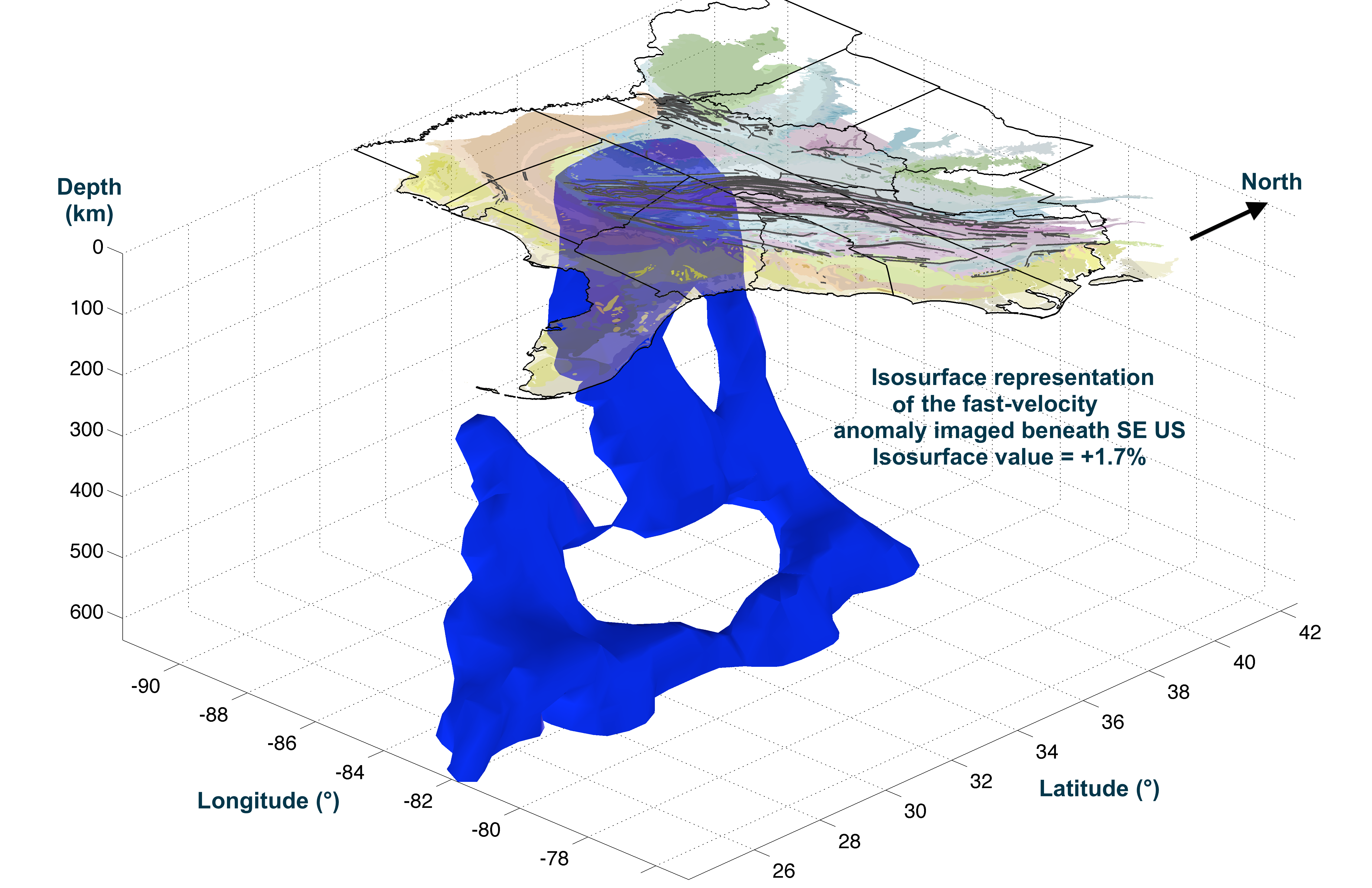
Imaging a Remnant Slab Beneath Southeastern US: New Results from Teleseismic, Finite-frequency Tomography.
Abstract:
Based on the amplitude, location and geometry of the velocity perturbation, we interpret this anomaly as remnant subducted lithosphere, suspended in the upper mantle after a subduction phase as young as 100-110 Ma or as old as 1Ga. Basic calculations and evaluations on the geometry and location of this anomaly help us to narrow down the origin of this slab to the Farallon flat-slab subduction in the west and Grenville Subduction during assembly of supercontinent Rodinia. Our images reveal possible mechanisms that would allow this slab to remain in the upper mantle without sinking into deeper mantle for such extended periods of time. We believe the flat geometry of the slab near the transition zone and the fragmented nature provide important clues about processes that could delay/resist the sinking while providing necessary time for it to transform into a more neutrally buoyant state. In this respect, we believe our results have broad implications for subduction processes and piece-meal slab failure, as well as tectonic implications for characteristics of former subduction zones that help shape North American Plate.