Numerical Simulation of Stoneley Surface Wave Propagating Along Elastic-Elastic Interface
Abstract:
Remarkably, all but one of the named waves were found and predicted theoretically as the results of mathematical and physical approaches in Nature exploration to be later confirmed in experiments and used in various scientific and practical applications. The only wave, which was not observed neither numerically nor experimentally until now is Stoneley wave. A likely reason for that is in rather restricted combinations of material parameters for this wave to exist. Indeed, the ratio R of shear velocities a model must be inside of the interval (0.8742 – 1). The ratio of the Stoneley wave velocity to the largest share wave velocity must be in the interval (0.8742 – R).
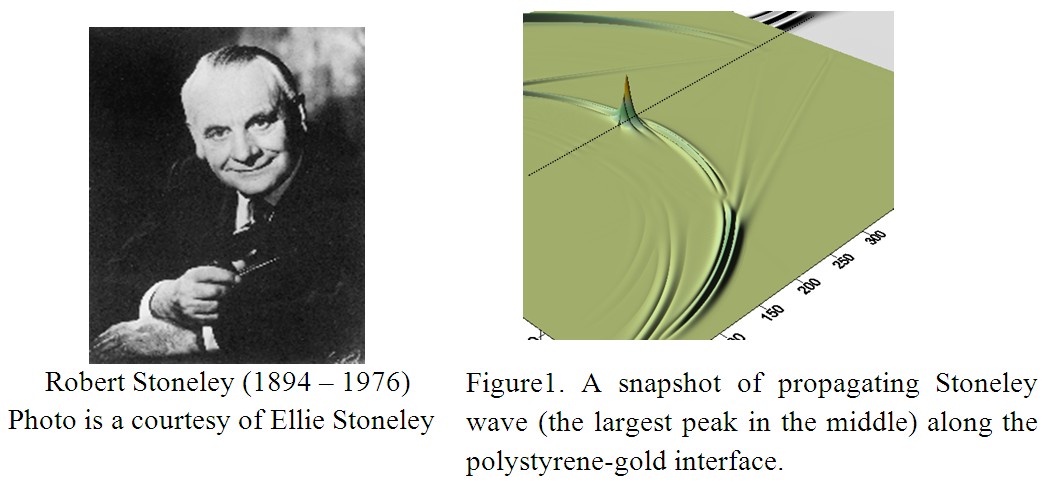
To fill the gap, we performed 2D finite-difference simulation for a model consisting of polysterene (with velocities Vp1=2.350 m/s, Vs1=1190. m/s, and density Rho1= 1.06 g/m3) and gold (with velocities Vp2=3.240 m/s, Vs2=1200. m/s, and density Rho2= 19.7 g/m3). A corresponded root of a dispersion equation was found with a help of original analytical solution developed by WaveLab. A point force source oriented along the meadia interfaces was used. A clear localized energy following the both direct shear waves is the Stoneley wave (Figure 1).