Magmatic recycling of lithospheric mantle and production of Oligocene-Pliocene alkaline mantle magmas at the end of Laramide subduction, Four Corners region, USA
Abstract:
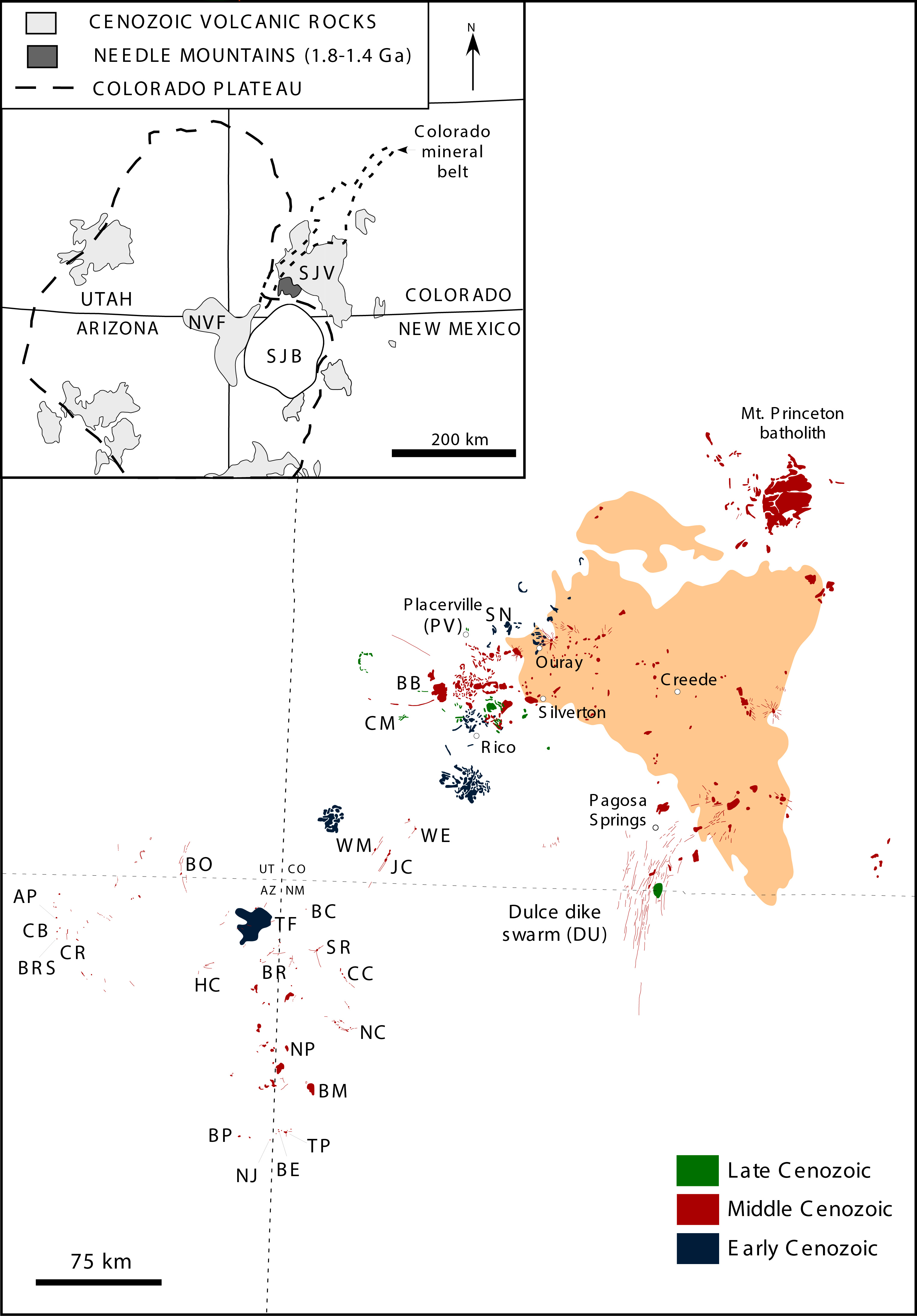
A northward decrease in intrusion age is mimicked by subtle variations in major and trace element geochemistry. Compared to the 20-5 Ma dike rocks, NVF intrusions have higher overall Mg# (> 55), K2O (5-6 wt. %), La/Lu (300–1000), and elevated concentrations of incompatible trace elements (e.g. Rb, Ba, Zr). The katungite samples are marked by extreme silica undersaturation (SiO2 ~34 wt. %), and higher MgO (~15 wt. %) and FeO (~13 wt. %) than the minettes. Isotopic signatures of the minettes are relatively homogenous, falling within a lithospheric mantle field spanning 87Sr/86Sr 0.705-0.707 and εNd +2 to -2; except the Dulce dikes which have anomalously lower εNd. Isotopic signatures of the katungites plot between the minettes and average OIB.
The spatial variations in geochemical signatures over time are attributed to either compositional variation in mantle sources ± different degrees of melting of lithospheric mantle; crustal contamination was insignificant. The lower concentrations of incompatible elements in the 20-5 Ma minettes might be explained by depletion of the lithospheric mantle caused by earlier voluminous volcanism in the San Juan Mountains. Alternatively, greater lithospheric fertility in Colorado may have promoted higher percentage partial melts in the mantle diluting the trace element concentrations of the 20-5 Ma minettes.