Using Sea Level to Probe Linkages Between Heat Transport Convergence, Heat Storage Rate, and Air-Sea Heat Exchange in the Subtropical North Atlantic
Abstract:
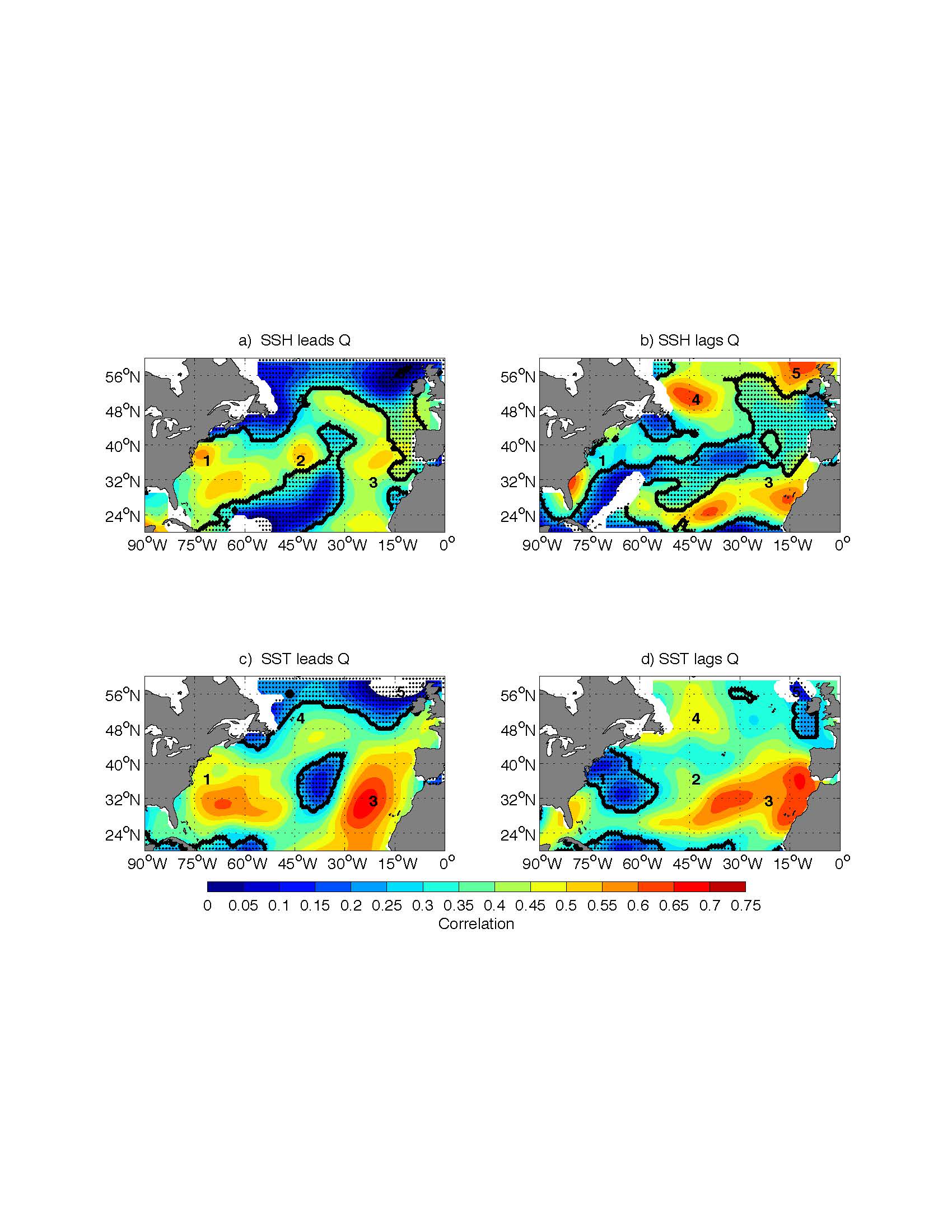
The twenty-year record of satellite sea level (SSH) along with high quality surface heat fluxes allow a detailed evaluation of the interaction between stored oceanic heat in this region and surface heat fluxes on interannual times scales. Using gridded sea level from AVISO as a proxy for upper ocean heat content along with surface turbulent heat flux from OAFlux, we evaluate the lagged correlations between interannual surface turbulent heat fluxes and SSH variability. Previous work has shown that where advection is small lagged correlations between SST (sea surface temperature) and surface turbulent heat flux are generally antisymmetric about zero lag with negative correlations when SST leads and positive correlations when SST lags. This indicates that surface heat fluxes force SST anomalies that at later times are damped by surface fluxes. In contrast, the lagged correlation between SSH anomalies and the turbulent flux of heat in the Gulf Stream region show a distinctly asymmetric relationship about zero-lag. The correlations are negative when SSH leads but are not significant when SSH lags indicating the dominant role in heat transport convergence in driving heat content changes, and that the heat content anomalies generated control the exchange of heat between the ocean and the atmosphere. Seasonal analysis shows that the Gulf Stream region’s heat content primarily is primarily released in winter and that in winter, SSH also gives significant predictive skill for mid-level cloud fraction.