Geochemical-Seismological Imaging of Volatile-Assisted Melting at the Southern Margin of the Colorado Plateau, USA
Abstract:
Melting of peridotite-dominated domains rather than lithologies that might have been introduced into the mantle by Laramide-aged shallow subduction are indicated by major element and transition metal signatures. The influence of subduction may nevertheless be recorded by moderately enriched isotopic compositions (εNd = -1.5 to +4.2; εHf= +5.5 to +11.8) that diverge from the mantle array. Trace element characteristics indicate variable mixtures of small degree melts (≤1%) generated in the garnet-stability field and melts generated at spinel stability conditions ± melt-rock reaction at the latter conditions.
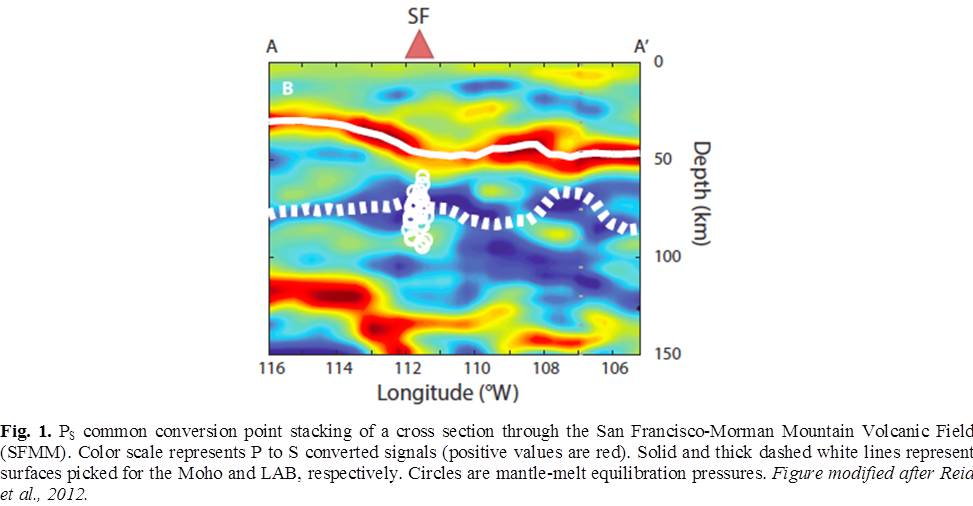
Thermobarometry results for clinopyroxene-bearing SFMM basalts indicate magmatic temperatures of 1250-1330°C at or just below the Moho. Melting conditions delimited from olivine-melt equilibra mostly range from ~90 km to just above the seismic proxy for the LAB. More deeply equilibrated melts appear to have greater contributions from asthenosphere-derived melts, and melt contributions may by hybridized by localized convective upwelling in response to LAB migration. Melt equilibration temperatures are 80-130°C higher than for clinopyroxene crystallization, assuming that melts have water contents (~0.5 wt.%) inferred from mantle xenoliths. This could be reconciled by melting/melt reaction involving a more hydrous CP mantle, capable of producing melts with ~3 wt.% water, potentially the remnant of Laramide-aged flat-slab subduction.
This project is supported by NSF EarthScope Grant EAR-1109826.