A Simple Model for the Viscosity of Rhyolites as a Function of Temperature, Pressure and Water Content: Implications for Obsidian Flow Emplacement
Abstract:
log η = -5.142+(13080-2982log(w+0.229))/(T-(98.9-175.9 log(w+0.229)))- P(0.0007-0.76/T )
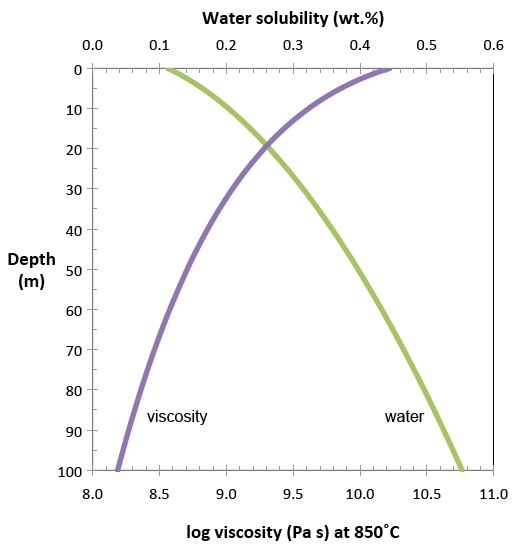
where η is in Pa s, w is water content in wt.%, P is in MPa and T is in K. The root mean square deviation (rmsd) between the model predictions and the 563 data points used in calibration is 0.39 log units. Experimental constraints have led previously to spurious correlations between P, T, X and η in viscosity data sets, so that predictive models may struggle to correctly resolve the individual effects of P, T and X, and especially their cross-correlations. The increasing water solubility with depth inside a simple isothermal sheet of obsidian suggests that viscosity should decrease by ~1 order of magnitude at ~20m depth and by ~2 orders of magnitude at ~100m depth. If equilibrium water contents are maintained, then deformation in spreading obsidian flows should be strongly partitioned into the deeper parts of the flow. Kinetically inhibited degassing, or recycling of degassed crust into a flow interior (e.g. by caterpillar-tread motion) could lead to strong lateral variations in viscosity within a flow, affecting flow evolution and morphology.