Irregular-Moons Science Today and in Cassini's Final Three Years
Abstract:
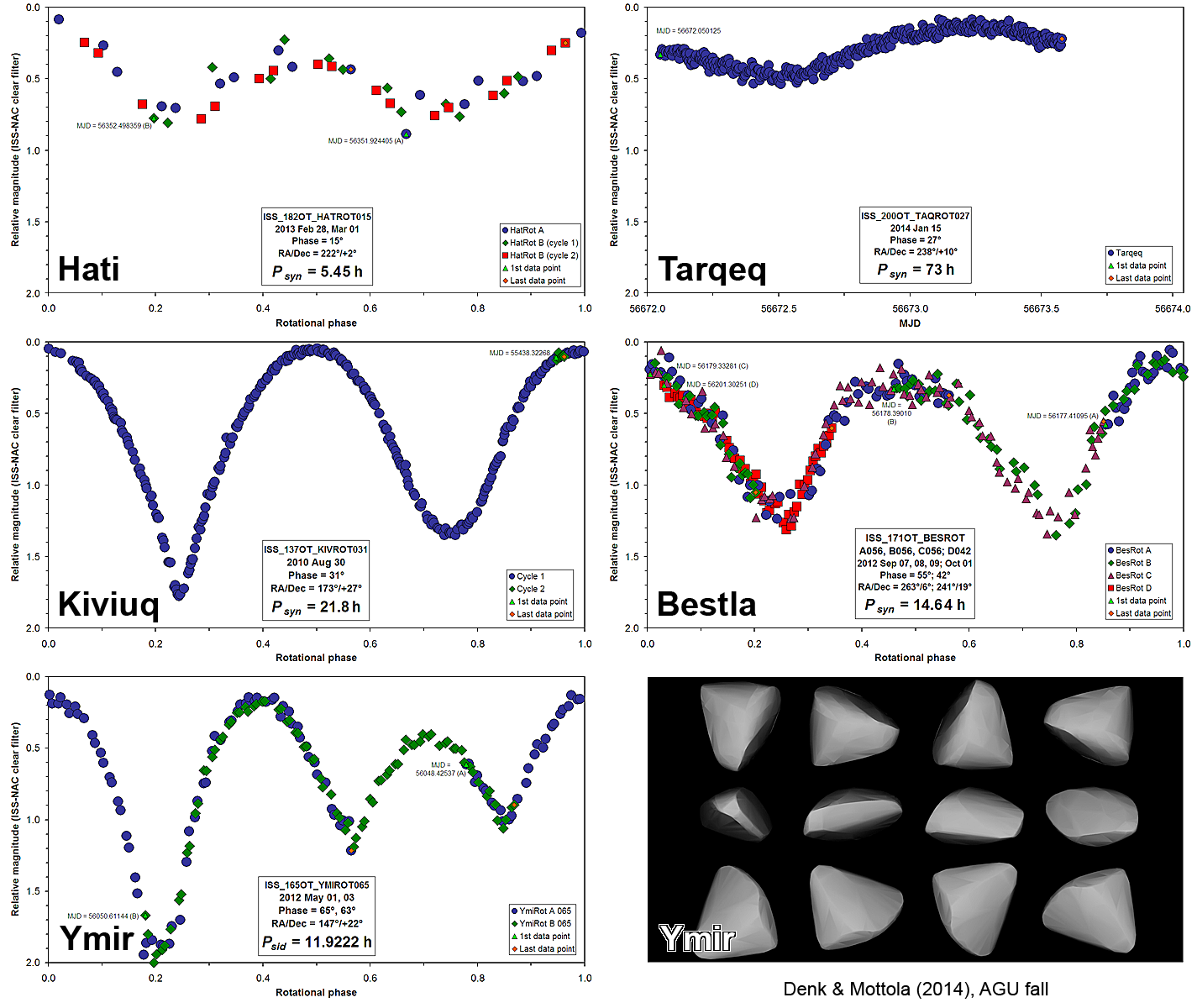
The Cassini ISS camera regularly observed the irregular moons over the last few years at various phase angles, with this research program now also being part of an accepted Participating Scientist proposal. Because of the large distances, the objects appear as unresolved point sources to the ISS. By means of photometric time series, rotational periods and minimum equatorial-axis ratios (a/b)min for 21 out of the 38 known objects could be determined. The rotation periods range from ~5½ hours for Hati to ~3 days for Tarqeq (Fig. top row). The largest (a/b)min are 2.9 for Kiviuq and 1.7 for Erriapus and Bestla (Fig. middle row).
Many objects are subject of repeated observations under varying illumination and viewing geometries, with the aim of determining pole-axis directions, convex-hull shapes, and sidereal periods. So far, lightcurve inversion of Ymir revealed a convex shape reminiscent to a triangular prism and a spin-axis direction close to the South Ecliptic pole. The figure shows the lightcurve at 64° phase (bottom left panel), and four equatorial and two polar views of the derived shape model are shown at bottom right.
Within Cassini's final three years in Saturn orbit, further observations offer the potential of pole and shape determinations for up to 15 irregular moons and up to 30 rotational periods total. These data may reveal (or already do so) hemispherical color variations, limits for object densities and sizes, pole-direction patterns, correlations of spin frequencies to orbit parameters, and hints for contact binaries or binary natures of the moons. Such information, besides its value per se, provides constraints for the investigation on the formation and evolutionary processes within the Saturnian satellite system.