Investigation of the Local Soil Effects at the New Strong-Motion Array (MATNet) in Hatay-K.Maras Region, Turkey
Abstract:
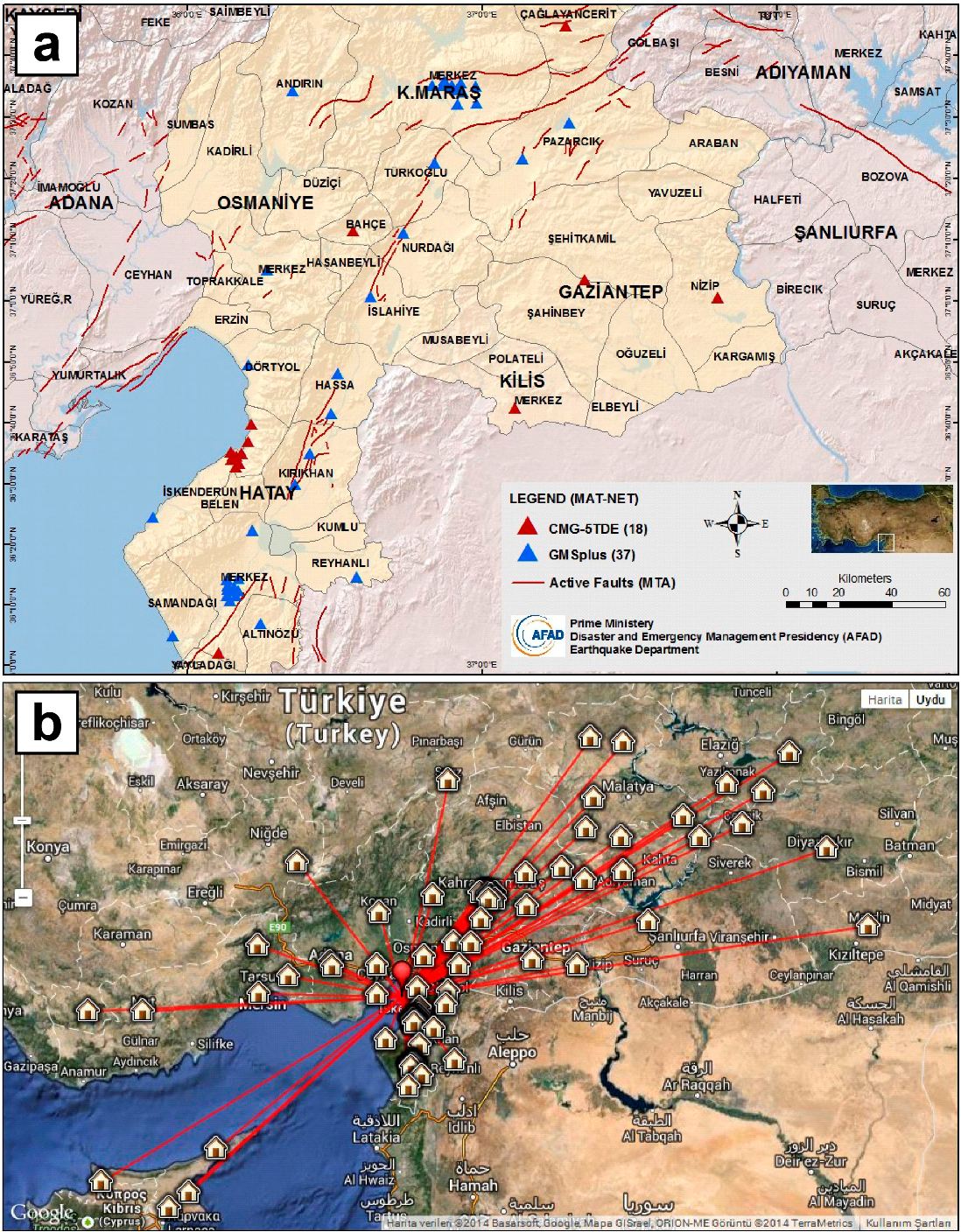
Hatay, Iskenderun and K.Maras cities have residential, industrial and dense populated areas. New stations are installed on different geological units in 1-3 km or 5-15 km intervals in city centers. Distances increase up to 30 km at the outside of settlements. The MATNet contains 55 triaxial force-balance accelerometers and capable to record explosions. A recent earthquake (Mw=4.5) occurred in the Gulf of Iskenderun on 14 February 2014, and triggered the MATNet and other regional accelerographs (80 triaxial strong-motion stations in total). Location of MATNet strong-motion stations in Hatay-K.Maras Region, Turkey, and distribution of triggered accelerometers during the recent earthquake (Mw=4.5), have been shown in the figure as a- and b-. In the present study, we analyzed to estimate the site response in the frequency range 0.5-10.0 Hz using the reference site (SSR) and HVSR techniques. The site response values thus obtained at each strong-motion sites were observed to be associated with the Quaternary formations. The maximum site amplifications at 0.5-1.8 Hz are detected as 10 around Hatay city, 6-8 (for 0.8-2.3 Hz) near K.Maras and Iskenderun areas. It is apparent that in both 0.5-1.8 and 0.8-2.3 Hz frequency bands, presence of geological contacts and sediment thicknesses controls the site responses in the study areas. It is also inferred that larger site response (~10) value in the 0.5 Hz frequency band could be indicating the probable presence of soil class C (360<Vs≤760 m/s) or D (180<Vs≤360 m/s) in the Hatay basin according to NEHRP provisions.