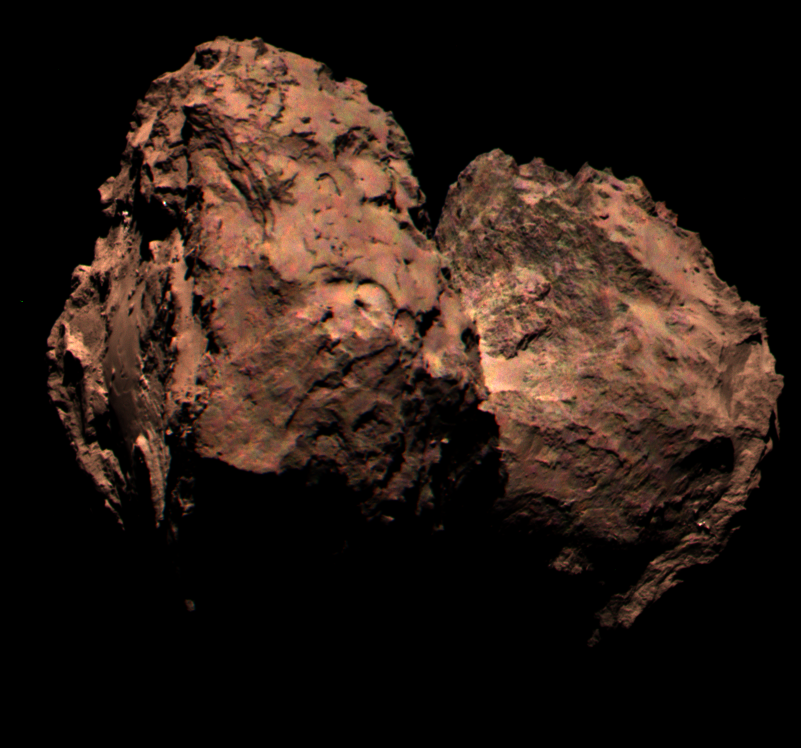
Color Variegation on 67P/Churyumov-Gerasimenko

Stubbe Faurschou Hviid1, Knollenberg Joerg1, Frank Preusker2, Stefano Mottola1, Ekkehard Kuhrt3, Stefan Schroeder2, Laurent Jorda4, Sonia Fornasier5, Jean-Baptiste Vincent6, Cedric Leyrat7, Nicolas Thomas8, Antoine Pommerol9, Maurizio Pajola10, Sebastien Besse11, Horst Uwe Keller12, Nilda Oklay13, Pedro Hasselmann5 and The OSIRIS Team, (1)German Aerospace Center DLR Berlin, Berlin, Germany, (2)German Aerospace Center (DLR), Berlin, Germany, (3)DLR, Berlin, Germany, (4)Observatoire Astrophysique Marseille, Marseille, France, (5)LESIA Observatoire de Paris, Meudon, France, (6)DLR Institute of Planetary Research, Berlin, Germany, (7)Paris Observatory Meudon, Meudon, France, (8)University of Bern, Bern, Switzerland, (9)University of Bern, Space Research & Planetary Sciences, Bern, Switzerland, (10)CISAS - Center for Studies and Activities for Space, University of Padova, Padova, Italy, (11)Aurora Technology B.V., European Space Astronomy Centre/ESA, Madrid, Spain., Villanueva De La Canada, Spain, (12)Technical University of Braunschweig, Braunschweig, Germany, (13)Max Planck Institute for Solar System Research, Katlenburg-Lindau, Germany
Abstract:
The ESA Rosetta Mission entered active operations around comet 67P/Churyumov-Gerasimenko in early August 2014. The full nucleus will be mapped at multiple resolutions before the Philae landing in November. The mapping will include imaging using the full spectral range of the Narrow Angle Camera of the OSIRIS imaging system (245nm to 1000nm in 11 optical filters). The color mapping will be done under good illumination condition at ~1m/pixel as part of the pyramid arc approach phase. This will later be followed by higher resolution imaging (down to 20 cm/pixels) of parts of the nucleus. These higher resolution images are acquired under somewhat worse illumination conditions because of the high angle between the orbital plane and the Sun direction.

This contribution will discuss the color variegation observed on the comet surface and its relationship to surface morphology and cometary activity.