Simultaneous Mapping of Titan’s Atmospheric and Surface Properties Through the Massive Inversion of Cassini/VIMS Data
Abstract:
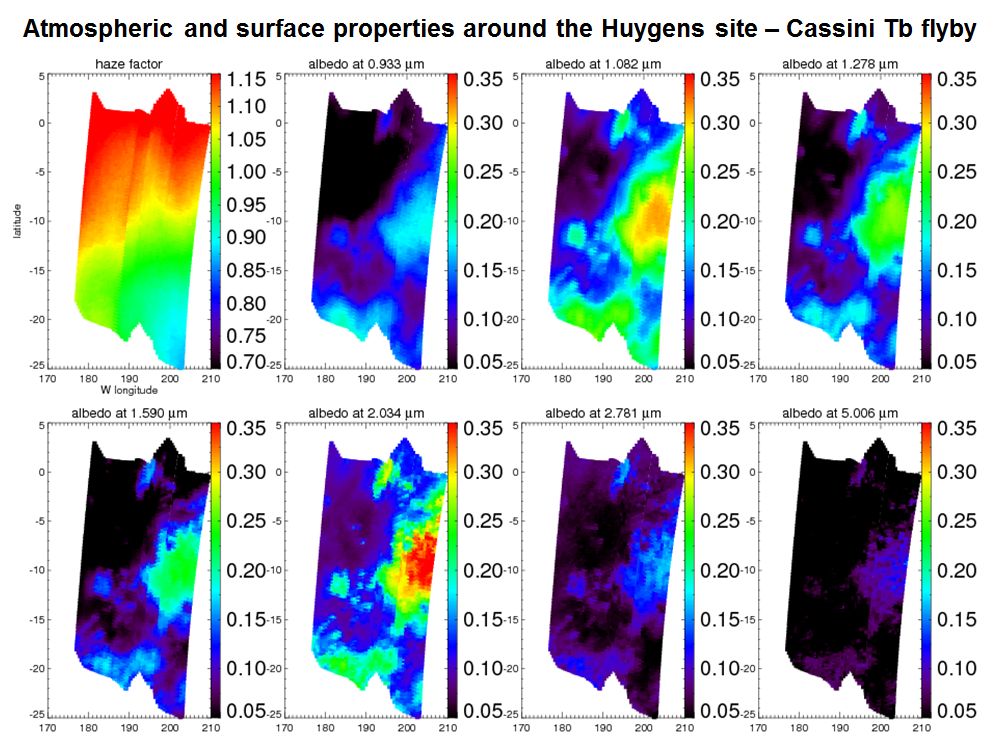
In our analysis we use a radiative transfer model to create look-up tables for different values of the model’s parameters (geometry of the observation, surface albedo, aerosols opacity). We employ up-to-date information on gaseous spectral coefficients, aerosols’ optical properties and Titan’s climatology. These look-up tables, appropriately interpolated, are then used to minimize the observations and create simultaneous maps of surface albedo at the wavelengths of Titan’s spectral windows and of aerosols opacity. This approach allows the gain of a factor of several thousands in computational time and thus, for the first time, a truly massive treatment of VIMS data. This capacity of processing full mapping quickly will consent to monitor closely the global and local seasonal evolution of the atmosphere and the surface.
We will present the results of our method applied to some cases of interest. We will analyze several hyperspectral images of the Huygens landing site and show the comparison of our results with observations of other Cassini instruments. We will also investigate regions that have been observed multiple times at different Cassini flybys with different observational conditions, as the T13/T17 mosaic of the Atzlan area. The perspectives for atmospheric and surface seasonal monitoring will be highlighted.