Microbially-influenced Fe-Cycling within high pH serpentinizing springs of the Zambales Ophiolite, Philippines
Abstract:
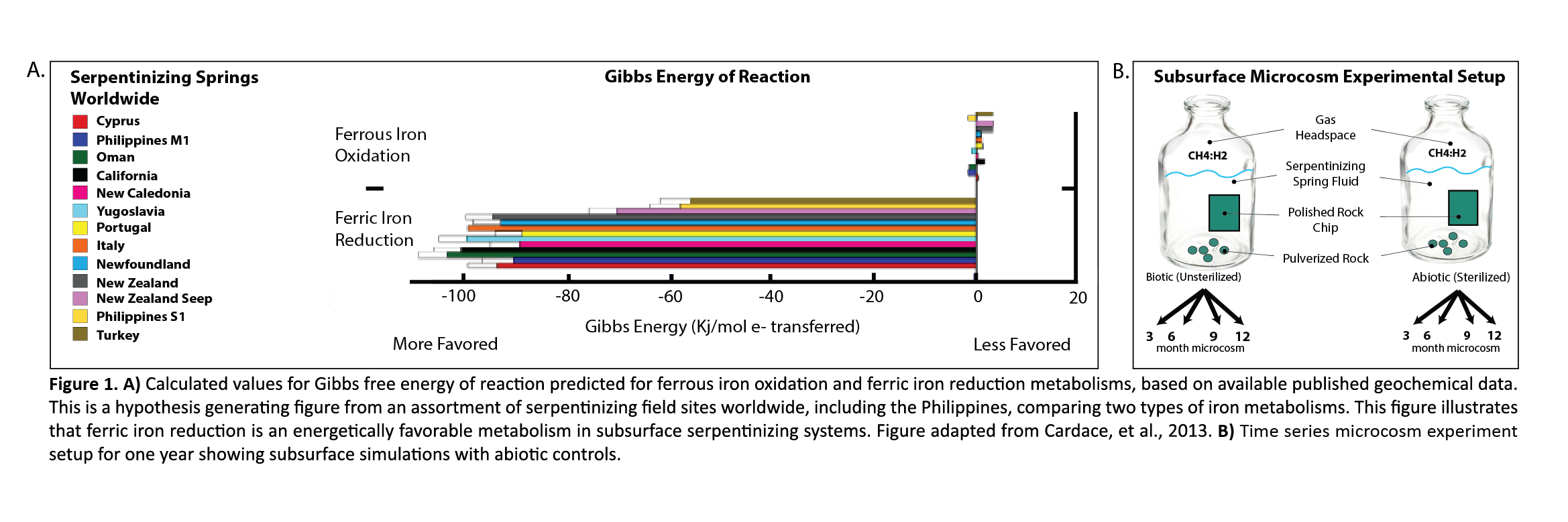
Spring fluid and rock samples from the Zambales region were collected in September 2013. Time series microcosms including sample rock, spring fluid, and gas simulating the spring surface and subsurface (Fig. 1B) will investigate microbial growth rates and microbial reaction products over one year. Microcosms will undergo cell counts via fluorescence microscopy, SEM, and XRD to examine cell growth rates, microbial action on mineral surfaces, minerals forming around cells, and changes in mineralogy. After one year, microbial community structure and iron metabolizers will be identified via DNA sequencing.
Surface microcosms are expected to show abiotic oxidation of Fe2+ and formation of Fe3+ precipitates preferentially around cells acting as nucleation sites (except in abiotic control microcosms). Subsurface microcosms are expected to show biotic reduction of Fe3+ and signs of microbial action on mineral surfaces. This activity will increase directly with increasing cell growth, and will not be evident in abiotic control microcosms. Evidence of reduced iron mineral formation over time will be seen, and DNA sequencing will yield consistent results with microbes capable of metabolizing iron, thus demonstrating microbially-influenced iron cycling in this system.