Time-Lapse Zirconography of Continental Growth
Abstract:
Here I use the novel approach of examining U-Pb zircon age spectra as a function of the age of the sediment in which the zircons are preserved. This produces time-lapse sequences of zircon age distributions, and presumably, crustal evolution. The database [1] is large enough (n>200,000) that time-lapse sequences can be constructed for each continent. To my knowledge, this approach has only been applied to the Australian zircon record [2].
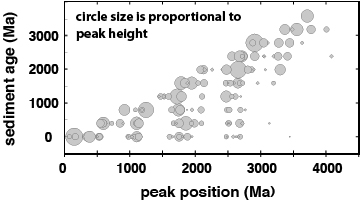
The results are quite clear (Figure 1; circles are positions of peaks (x-axis) in detrital zircon U-Pb age spectra in different age sediments (y-axis), size of circle is proportional to the height of the peak). There are no major zircon U-Pb age peaks in the ranges 2.2-2.4 Ga and 1.3-1.6 Ga in any sediment of any age on any continent. While some crust was produced at these times, there is no evidence in the zircon record that substantial amounts of crust of these ages ever existed, suggesting that the troughs in the age spectra are due to substantial decreases in (though not cessation of) crustal production.
In contrast, U-Pb age peaks between 2.5 and 2.7 Ga appear in sediments immediately after these times and persist in subsequent sedimentary records. The peak heights decrease steadily through time, indicating that crustal destruction is a significant process in modifying the zircon record, but is not responsible for producing the peaks. The same pattern is seen for age peaks at 1.6-2.1 and 1.0-1.3 Ga. Comparing the time-lapse results with Hf isotopes in zircons and Os isotopic ages of lithospheric mantle suggests continental growth largely occurred in pulses between 2.8 and 1 Ga. Subsequent to 1 Ga, the zircon record seems to be dominated by crustal reworking.
[1] Voice et al (2011) J Geology 119:109-126. [2] Hawkesworth et al (2010) J Geol Soc Lon 167: 229-248.