The Human Thirst for Water Under Global Change: What and where are the Future Risks?
Abstract:
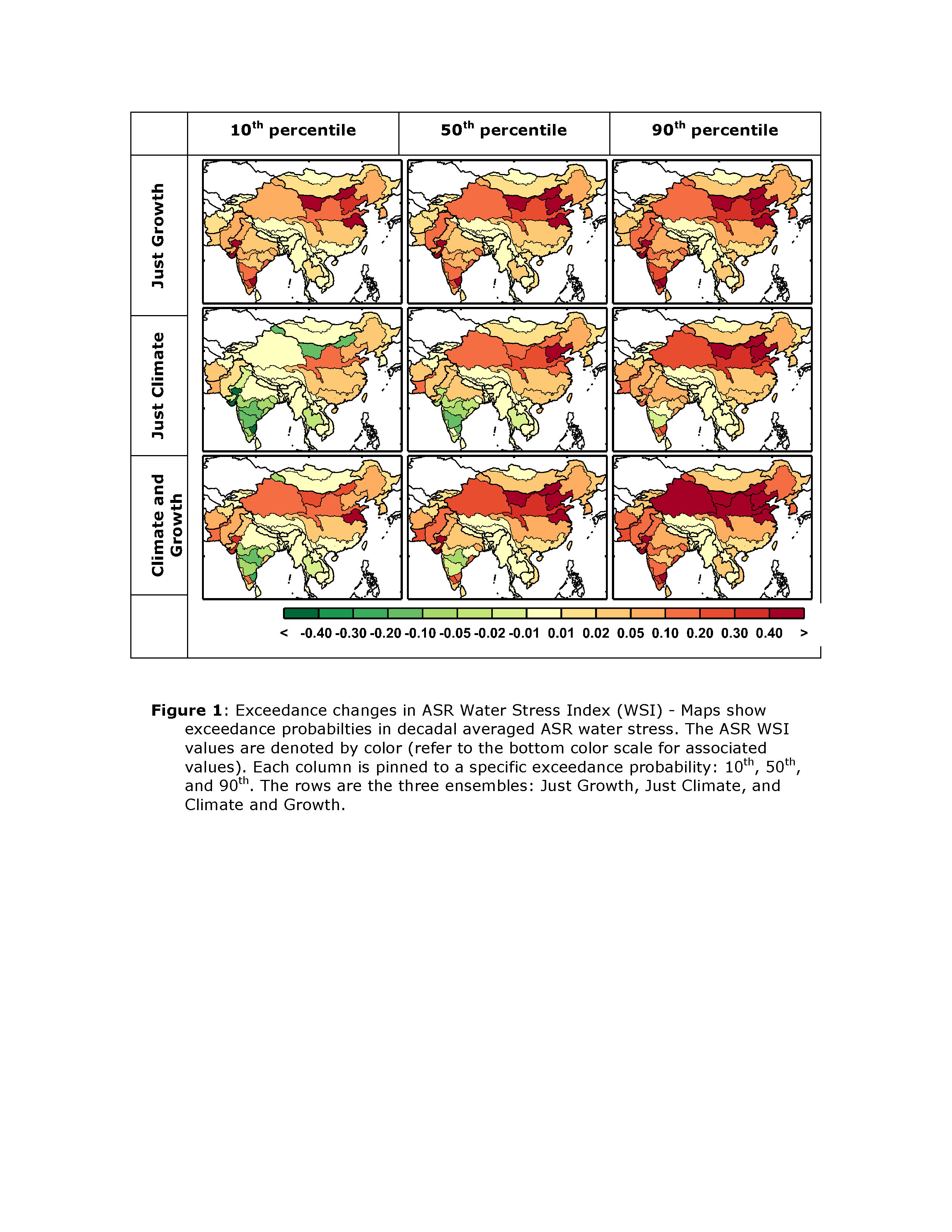
We present a synopsis of recently published and ongoing analyses from experiments with the MIT Integrated System Model (IGSM) linked to a Water Resource System (WRS). These experiments address the future of water stress in a global context as well as with regional lenses over the United States and a large portion of Southern and Eastern Asia. By 2050, global economic growth and population change can lead to an additional 1.8 billion people living under at least moderate water stress, with 80% located in developing countries. Combined, socioeconomic growth and uncertain climate change lead to a 1.0–1.3 billion increase of the world’s 2050 projected population living with overly exploited water conditions—where total potential water requirements will consistently exceed surface water supply. Using a large ensemble of scenarios that are consistent across economics, emissions, climate, population, etc., we develop risk portfolios of water stress over a large portion of Asia (Figure 1) and isolate the effects of socioeconomic growth (population and wealth) and climate change. We find the number of people under water stress more than doubles from about 800 million to 1.7 billion by 2050. These insights point to needed actions to adapt and protect future water supplies. Further experimental simulations are presented to demonstrate the utility of widespread adaptive measures that include: enhanced storage and transfer as well as water-use efficiency and reduced consumption.