Foliar Temperature Gradients as Drivers of Budburst in Douglas-fir: New Applications of Thermal Infrared Imagery
Abstract:
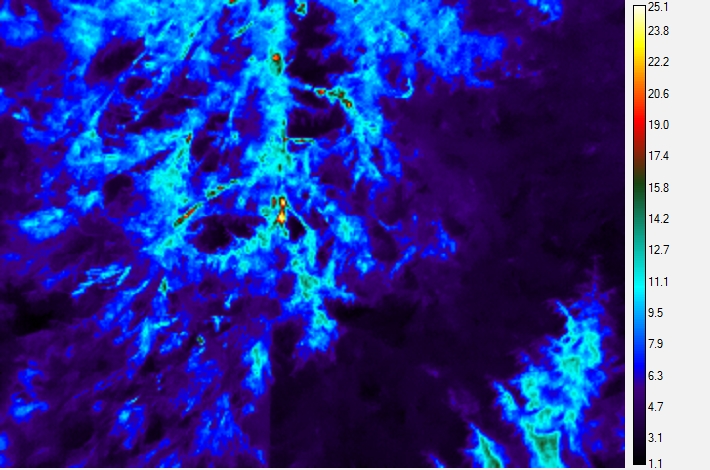
We use a novel remote sensing approach, combined with on-site meteorological measurements, to demonstrate important intra-canopy differences between air and foliar temperature. We mounted a thermal infrared camera within an old-growth canopy at the H.J. Andrews LTER forest and imaged an 8m by 10.6m section of a Douglas-fir crown. Sampling one image per minute, approximately 30,000 thermal infrared images were collected over a one-month period to approximate foliar temperature before, during and after budburst. Using time-lapse photography in the visible spectrum, we documented budburst at fifteen-minute intervals with eight cameras stratified across the thermal infrared camera’s field of view. Within the imaged tree’s crown, we installed a pyranometer, 2D sonic anemometer and fan-aspirated thermohygrometer and collected 3,000 measurements of net shortwave radiation, wind speed, air temperature and relative humidity. We documented a difference of several days in the timing of budburst across both vertical and horizontal gradients. We also observed clear spatial and temporal foliar temperature gradients. In addition to exploring physical drivers of budburst, this remote sensing approach provides insight into intra-canopy structural complexity and opportunities to advance our understanding of vegetation-atmospheric interactions.