Atmospheric expansion in runaway greenhouse atmospheres: the inner edge of the habitable zone depends on planet mass
Abstract:
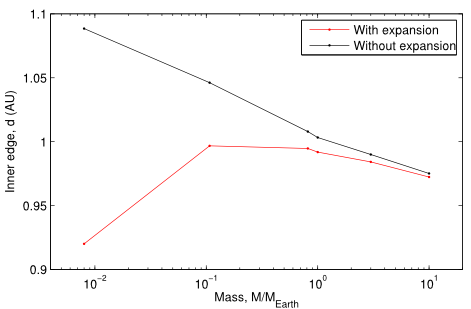
Returning to the first sentence, we generate a thick atmosphere: the height of optical depth of unity becomes a non-trivial fraction of the planetary radius. Hence the area of the absorbing and emitting surfaces increase. Thermal emission wins slightly, as this occurs higher, increasing thermal emission in all cases. The underlying tendency is for a larger thermal limit for heavier planets due to pressure effects, making these appear more resistant to a runaway. However, atmospheric expansion affects light planets more, making these seem much more resilient. The least resilient planet would be between Mars-size and Venus-size (Figure 1).
It would be foolish to regard small planets as habitable. As the atmospheres become large, so does the problem of atmospheric escape. Theoretical considerations show hydrodynamic escape to happen disastrously for a Europa-size planet. The observation is that Mars is too feeble to hold on to any hefty atmosphere, even far from the Sun as it is, is probably relevant too. The take home points for habitable zone nerds are: (1) planet size matters (2) for small planets, atmospheric escape from a "moist greenhouse" state, with habitable surface temperatures, is the mortal wound.
[1] Goldblatt, C., Robinson, T.D., Zahnle, K.J. & Crisp, D., Low simulated radiation limit for runaway greenhouse climates, Nat. Geosci, 6, 661-667, doi:10.1038/NGEO1892