Mesoscale variability in the Arabian Sea and its impact of the Persian Gulf Water.
Abstract:
Using monthly averaged altimetric, winds, heat fluxes and thermohaline data, we describe the onset and evolution of the mesoscale eddies and other features in the Northern Arabian Sea and their variations between each seasons and every years. Those structures have a deep reaching impact on the water masses, particularly on the PGW.
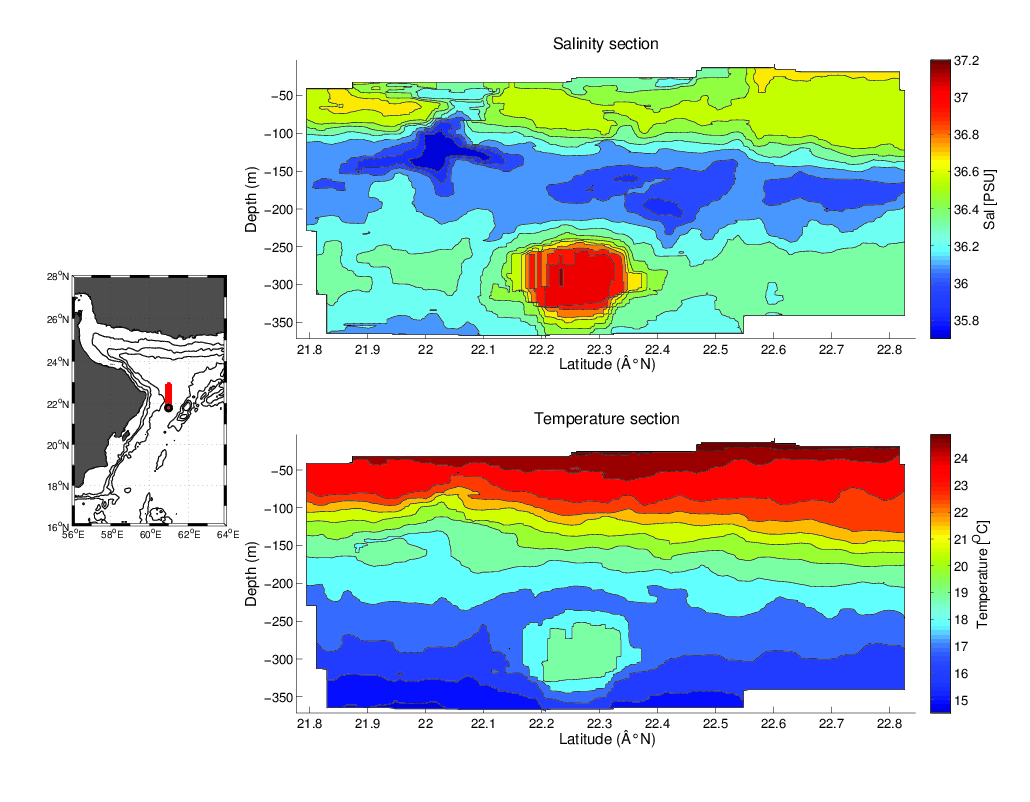
From here we will focus on the spring intermonsoon, a season in which the circulation in less wind driven, as the summer or winter. We will use the results from the PhysIndien 2011 experiment directed by the SHOM. EOFs extracted from altrimetric data show that this year is representative of this season. With a higher spatial resolution we focus on the advection of the PGW by the mesoscale gyres. Three of them, one cylonic and two anticyclonics, stay stationnary through the season along the Omani coast. They advect diluted PGW far South from its known climatological extension. As well they send the PGW vein through the Iranian coast and break the current in submesoscale structures; filaments and a lens of PGW were recorded during the experiment. Using the results on the mesoscale circulation, we will present the characteristics and trajectory of such a PGW lens.