Maruyamaite, a new K-dominant tourmaline coexisting with diamond –an important accessory mineral in UHP rocks
Abstract:
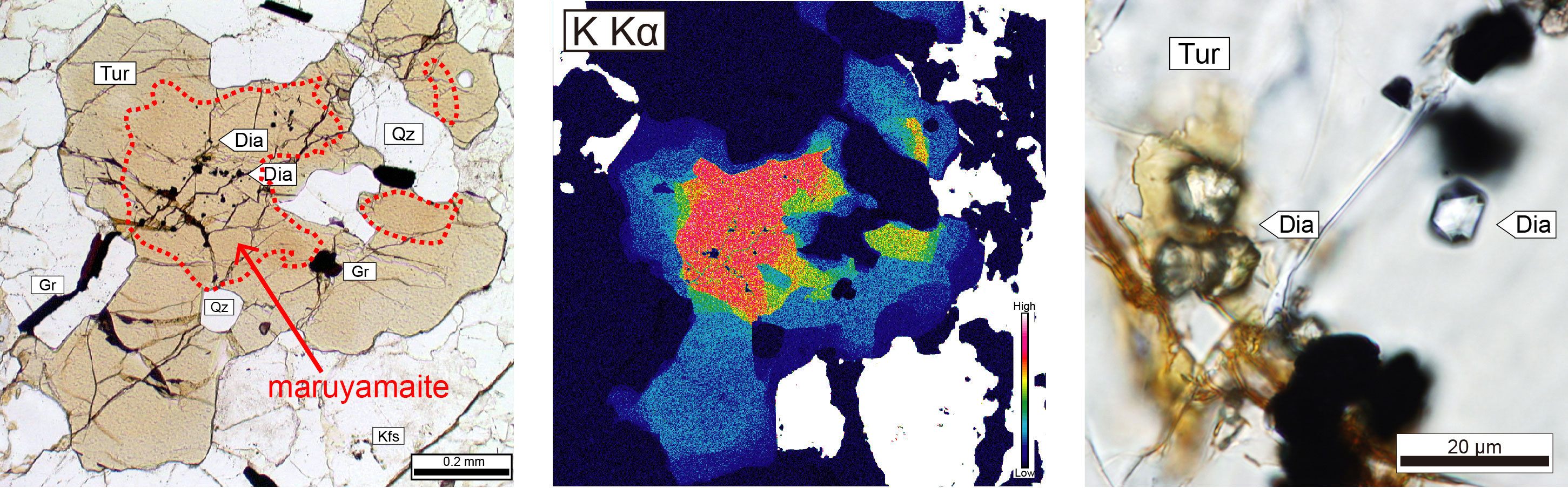
The systematic chemical analysis combined with detailed inclusion study (Shimizu & Ogasawara, 2013) demonstrated that K in tourmaline decrease with pressure decrease in the diamond-bearing Kokchetav UHP rocks and the maruyamaite component can form continuous solid solutions with dravite–oxy-dravite–uvite tourmalines. The figure shows that microdiamond inclusions occur only in K-dominant core (maruyamaite) and the surrounding parts contain low-pressure minerals such as graphite and quartz. UHP partial melting was deduced for the genesis of the maruyamaite-bearing tourmaline-rich quartzofeldspathic rock from the heavy B-isotope composition of maruyamaite (Ota et al., 2008). Contrarily, Marschall et al. (2009) and Korsakov et al. (2009) insisted that K-rich tourmaline was not UHP phase because of the significantly young 40Ar/39Ar age compared to the peak metamorphism. However, the K-content of tourmaline used for their dating is not more than 1.6 wt% (i.e., the tourmaline was not maruyamaite but K-rich (oxy-) dravite), suggesting the age may represent a later event during exhumation.
K-bearing tourmalines including maruyamaite could be a UHP indicator.