Forecasting the magnetic vectors within a CME at L1 by using solar observations.
Forecasting the magnetic vectors within a CME at L1 by using solar observations.
Abstract:
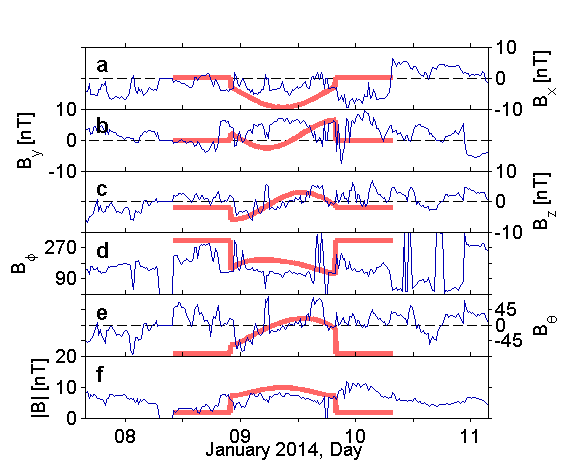
The direction of magnetic vectors within coronal mass ejections has important consequences to forecasting terrestrial behaviour, however forecasting these vectors remains predominately elusive. Here, we report that a simplified system is capable of replicating the broad field rotations seen within flux rope CMEs at L1 monitors. The predictions are performed under three main themes: 1) The majority of the field rotations can be simplified to the constant-alpha force-free (CAFF) flux model first implemented circa 1990. 2) The helicity will follow the Bothmer & Schwenn system that relies on a reliable helicity prediction of active regions during solar cycle. Which has been recently confirmed by Wang [2013 ApJ]. 3) The majority of the distortions, deflections and rotations will have already occurred within coronagraphic field of view, thereby allowing the creation of a projected “volume-of-influence” on the Sun, from which Earth’s position relative to the CME can be estimated. This presentation will compare predicted results to the observations from 7 CME events and then estimate the sources of uncertainty. As an example, the difference in robust statistics from 2 solar cycles of CAFF model fittings for the field magnitude will be compared to estimates generated from simulated CME-sheaths within forecasting Enlil runs.
The figure displays an example field vector forecast from the techniques employed above.