Contemporary Subsoil Carbon Accumulation During Reforestation is Conditioned by Long-term, Coupled C-Fe Cycling in Upland Soils
Abstract:
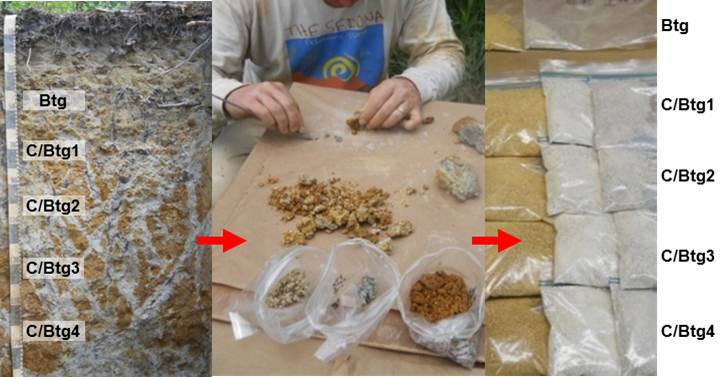
Bulk subsoils, however, were extremely heterogeneous and contained three well-defined redoximorphic feature microsites. Over the lifetime of these upland soils, coupled carbon-iron cycling during transient oxygen limitation created the microsites and thereby imparted subsoils with steep biogeochemical gradients millimeters to centimeters apart. Concentration of operationally defined crystalline iron-oxyhydroxides was on average ten times higher in Fe-enriched microsites (30.1 ± 2.5 mg/g, mean ± 1 SE) than Fe-depleted microsites (2.9 ± 0.3 mg/g) and gley microsites (3.3 ± 0.4 mg/g) across the catena. Under the deeply rooted forest Δ14C in gley microsites and Fe-depleted microsites was enriched by an average of 73‰ (p=0.0194) and 94‰ (p=0.0416), respectively relative to the same microsites under grass. Meanwhile, Δ14C in Fe-enriched microsites was unchanged by the divergent rooting regimes (p=0.1936). These microsite dependent patterns of radiocarbon enrichment indicate that subsoil C stabilization during reforestation of the catena was spatially conditioned by historic coupled carbon-iron cycling. We detail the mechanisms of this conditioning, and argue that similar long-term biogeochemical processes influence contemporary subsoil C stabilization and change more often than is commonly appreciated.