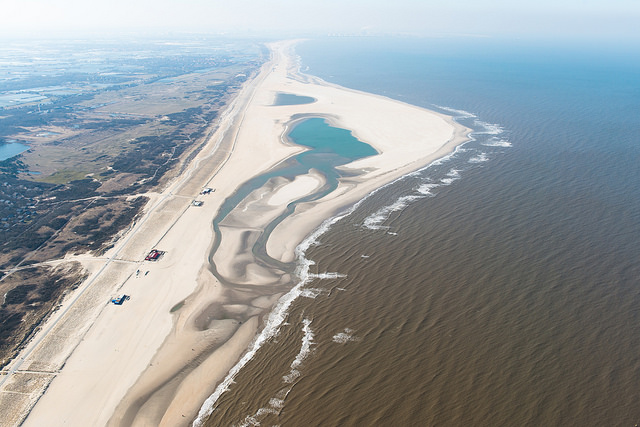
The mobilization of toxic trace elements due to pyrite oxidation at the mega-nourishment The Sand Motor, the Netherlands
Abstract:
The sediment was taken 10 km out of shore from the sea floor, which was at a depth of 20 m. Grab samples of the upper 25 cm seabed analyzed for geochemical mapping of Southern North Sea sediments, show locally high contents of sulfur, iron and trace elements like arsenic indicating presence of pyrite with impurities. Sediment was removed to a maximum depth of 6 m below sea floor, reaching different geological layers including bog iron ore layers.
Different degrees of pyrite oxidation are expected with depth at the Sand Motor. First, minimum oxidation when sediment was deposited from the ship directly by opening the bottom floor, which is now present under water at the deepest part of the nourishment. Second, limited oxidation when sediment was applied from the ship under high pressure through the air, and settled below sea level. Last, maximum oxidation when the same method was used but the sediment remains located in a surface layer having a maximum height of 4 m above sea level.
At the Sand Motor, samples were taken of surface water, pore water and sediment from the surface to a depth of 10 m, the bottom of the nourishment. Analyses show that pyrite oxidation has occurred above sea level and mobilization of arsenic is present up to a maximum concentration of 92 ug/L in shallow pore waters.
Fine grained material will be transported towards the dune area with the development of the Sand Motor. As a result, heavy particles including shells and bog iron ore fragments get enriched at the surface. The bog iron ore fragments contain high arsenic contents of 391 ppm. The risk of human exposure asks attention as the Sand Motor is also a recreational area.