Temperature Trends in the White Mountains of New Hampshire
Abstract:
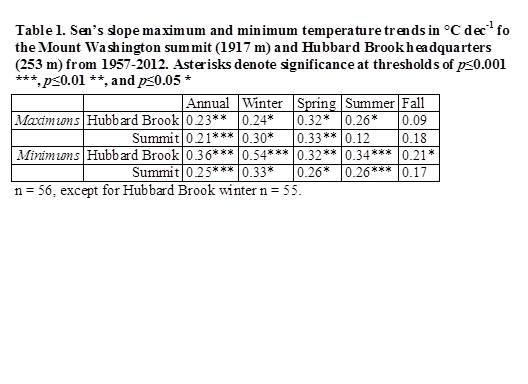
Using Sen’s slope and the Mann Kendall non-parameteric test we examine annual and seasonal trends in minimum, maximum, and mean temperatures. Both Mount Washington and Hubbard Brook exhibit 56-yr warming trends for most seasons, however, the magnitudes and statistical significances are variable, suggesting the processes controlling these trends likely differ with elevation. Since 1957, for instance, spring maximum temperatures at Hubbard Brook have warmed 0.32 °C dec-1 and winter minimums have increased 0.54 °C dec-1, both well within the range reported for six neighboring low elevation stations from 1970-2012 (Wake et al, 2014a,b). In comparison, Mount Washington summit seasonal minimum temperature trends are typically weaker, with changes in winter minimums (the largest of the seasons) reaching only 0.33 °C dec-1.
In this presentation, we highlight differences between these two long-term records and discuss possible role of moist processes and boundary layer/free troposphere exposure in causing their divergence. Authors are planning to study the effects of humidity and cloud-cover on summit temperatures and to investigate how changes in the frequency with which the summit is exposed to boundary layer and free tropospheric air masses influences these relationships.