Empirical Photometric Normalization for the Seven Band UV-VIS Lunar Reconnaissance Orbiter Wide Angle Camera
Abstract:
The WAC has a 60° cross-track field-of-view in color mode, which allows the acquisition of a near global data set each month; however, the phase angle can change by as much as 60° across each image. These large changes in viewing geometry present challenges to the required photometric normalization. In the ratio of the 321 nm and 689 nm wavelengths, the Moon has a standard deviation less than 3% in the highlands and 7% globally; thus to allow confident identification of true color differences, the photometric normalization must be precise.
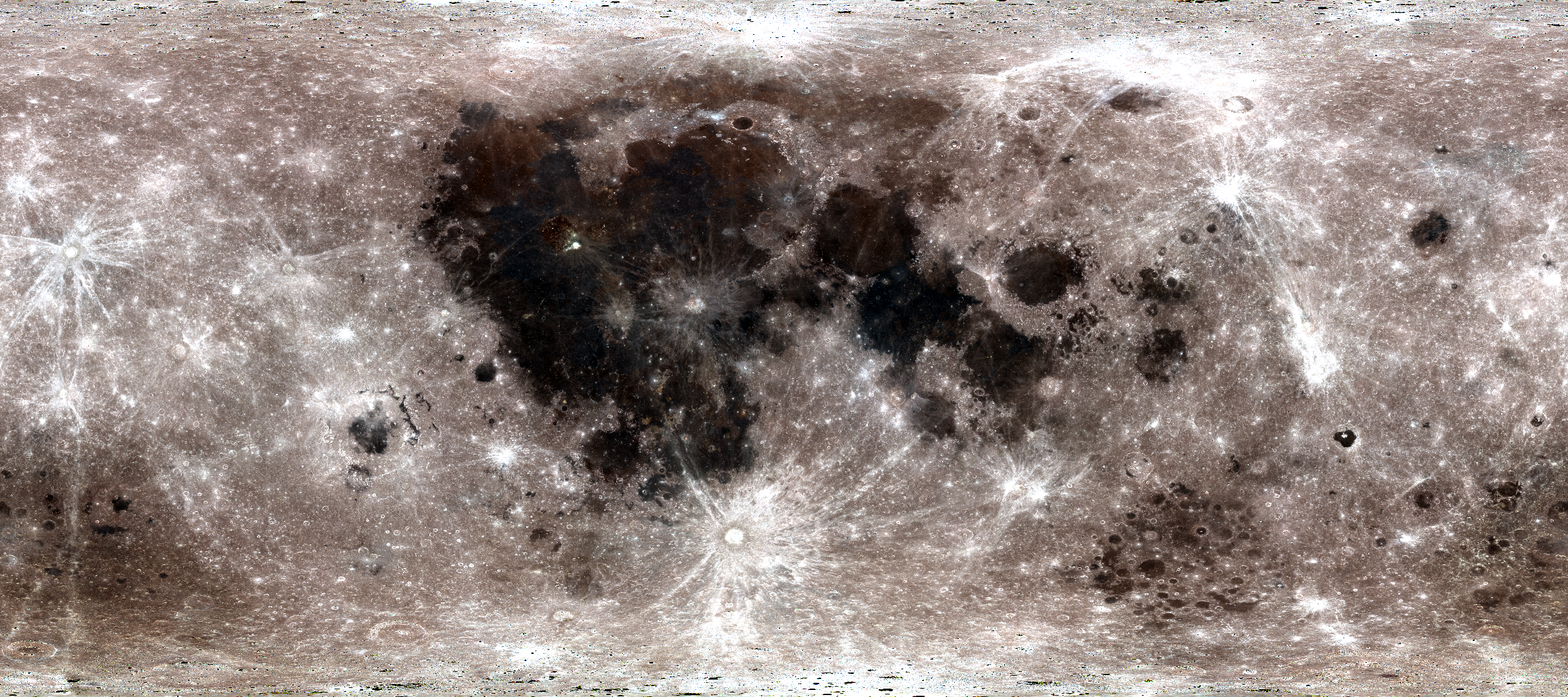
Pyroclastic deposits in Marius Hills, Sinus Aestuum, and Mare Serenitatis are among the least reflective materials, with 643 nm normalized reflectance values less than 0.036.
Low-reflectance deposits are generally concentrated close to the equator on the nearside, whereas high-reflectance materials are dispersed globally. The highest reflectance materials occur at Giordano Bruno and Virtanen craters and are attributed to exposure of immature materials. Immature ejecta has shallower spectral slope compared to the mean highlands spectra (321 nm to 689 nm), and UV weathering characteristics can be seen when comparing different aged Copernican ejecta [2]. Copernican ejecta is found to have 643 nm reflectance values greater than 0.36 in some areas. The range of reflectance on the Moon is 10x from the least to most reflective.
The new empirical normalized reflectance presented here correlates with an independent Hapke model based normalization [3] with an R-squared value of 0.985.
[1] Scholten et al. LPSC XVII (2011) [2] Denevi et al. JGR Planets (2014) [3] Sato et al. JGR Planets (2014)