Biogeochemical Transformation Pathways through the Land-water Geosphere
Biogeochemical Transformation Pathways through the Land-water Geosphere
Abstract:
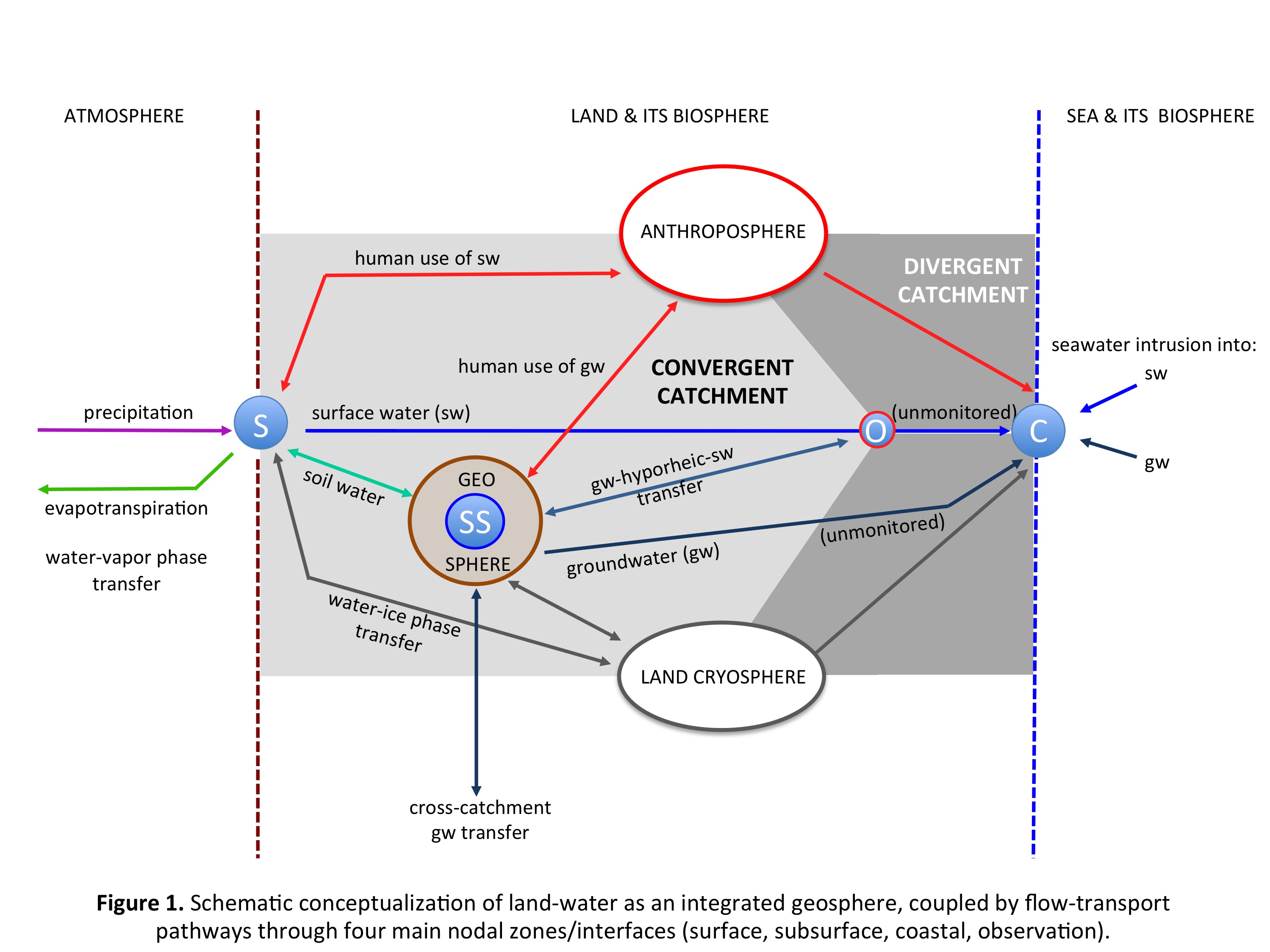
Water on land undergoes and participates in many biogeochemical exchanges and changes. A bits-and-pieces approach to these may miss essential aspects of change propagation and transformation by land-water through different segments of the Earth system. This paper proposes a conceptualization of the entire land-water geosphere as a scale-free catchment-wise organised system (Figure 1), emphasizing four key new system aspects compared to traditional hydrosphere/water cycle view: i) distinction of coastal divergent in addition to traditional convergent catchments; ii) physical and social-ecological system coupling through four main nodal zones/interfaces (surface, subsurface, coastal, observation); iii) flow-transport pathways as system coupling agents; iv) multiple interactions with the anthroposphere as integral system parts. Utilizing this conceptualization, we identify distinct patterns of direct anthropogenic change in large-scale water and waterborne nutrient fluxes, emerging across different parts of the world. In general, its embedment directly in the anthroposphere/technosphere makes land-water a key geosphere for understanding and monitoring human-driven biogeochemical changes. Further progress in system-level understanding of such changes requires studies of land-water as a continuous yet structured geosphere following the proposed spatiotemporal pathways of change propagation-transformation.