Inverting for Shear Stress Rate on the Northern Cascadia Megathrust Using Geodetic Data
Abstract:
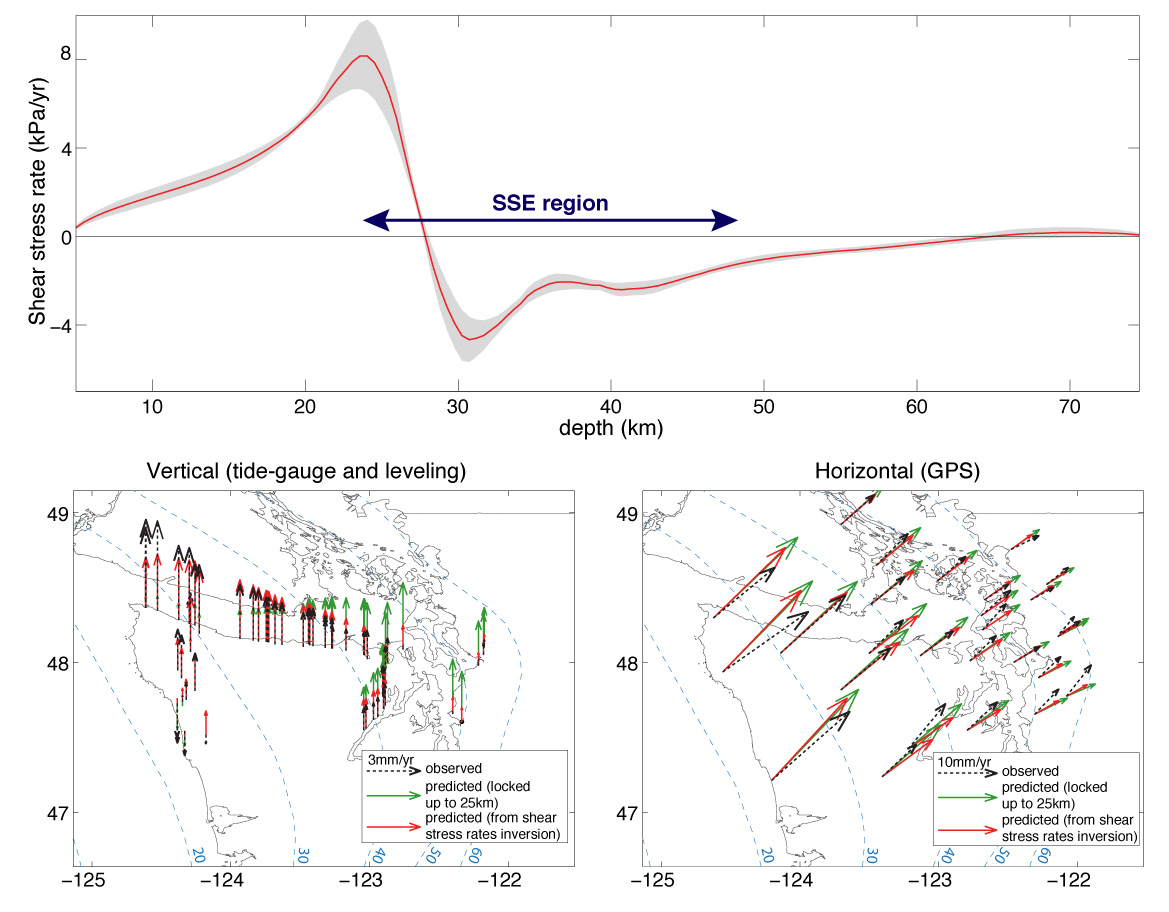
Our inversions of geodetic data for fault slip rates exhibit a steeper slip-rate profile at the top of the ETS zone, relative to the constant shear stress model, as well as creep up dip of the ETS zone. We explore physics-based models with velocity-strengthening regions of different length up dip the ETS zone, i.e. within the “gap” identified in kinematic inversions. However, this still does not match the observations well. We therefore try a new approach: we invert for shear stress rates on the megathrust that best fit the data. We show that a small decrease in shear stress within the top of the ETS zone, reaching 5 kPa/year at a depth of ~ 30 km, is required to fit the data. Possible explanations for this include a slow decrease in normal stress with time, possibly due to an increase in pore pressure, or a reduction in fault friction. We explore these hypotheses, using 2D quasi-dynamic simulations with rate-and-state friction and isothermal v-cutoff models for generating slow slip events. The potential for creep above the top of the ETS zone has important implications for the mechanical relationship between deep slow slip and dynamic events in the locked region.