Does Crustal Rheology Impact Melt Composition during Continental Break-up?
Abstract:
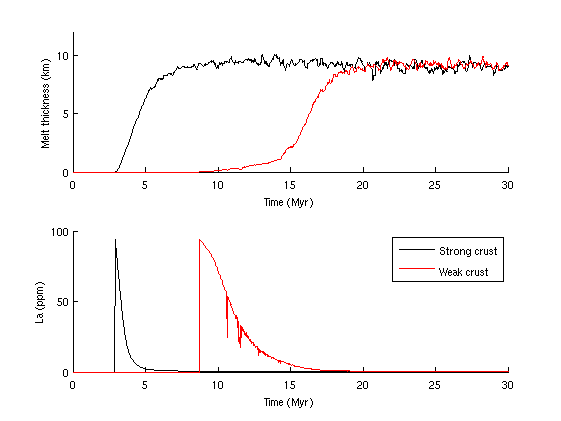
We explore various Arrhenius type rheologies where the principal difference between 'strong' and 'weak' forms is a six order of magnitude larger pre-factor. The result of a large reduction in the strength of the lower crust is to delay melt generation and reduce the melt production rate. For the strong model focused strain results in a narrow, shallow region of partial melting and a rapid reduction in light REE concentrations. For the weak model extension is more distributed resulting in a period of time where melting is held at depth due to the protracted thinning of the crustal lid. This reduces the melt production rate and the rate of change in composition. The difference in melt generation only exists during rifting: all models reach the same steady-state as this is a function of mantle temperature. In Afar, kinematic reconstructions would suggest that the onset of extension becomes younger in the north as the region 'un-zipped'. Our model implies that the younger Erta Ale segment has a strong crust, extension is focused and current magmatism represents the first signs of melting (given the light REE enrichment). To the south the onset of extension is older, the crust is weaker and melting is somewhat restricted to deeper depths. Volcanism during break-up is therefore influenced by crustal rheology.