Urban Heat Island Versus Air Quality – a Numerical Modelling Study for a European City
Abstract:
The goal of this study is to investigate the effect of, e.g., high reflective surfaces and urban greening on mitigating the UHI and the related impact on air quality. A multi-layer urban canopy model is coupled to the mesoscale model WRF-Chem and the urban area of Stuttgart (South-West Germany) is taken as one example. Different scenario runs are executed for short time periods and are compared to a control run.
The results show that the UHI effect can be substantially reduced when changing the albedo of roof surfaces, whereas the effect of urban greening is minor. Both scenarios have in common, that they evoke changes in secondary circulation patterns.
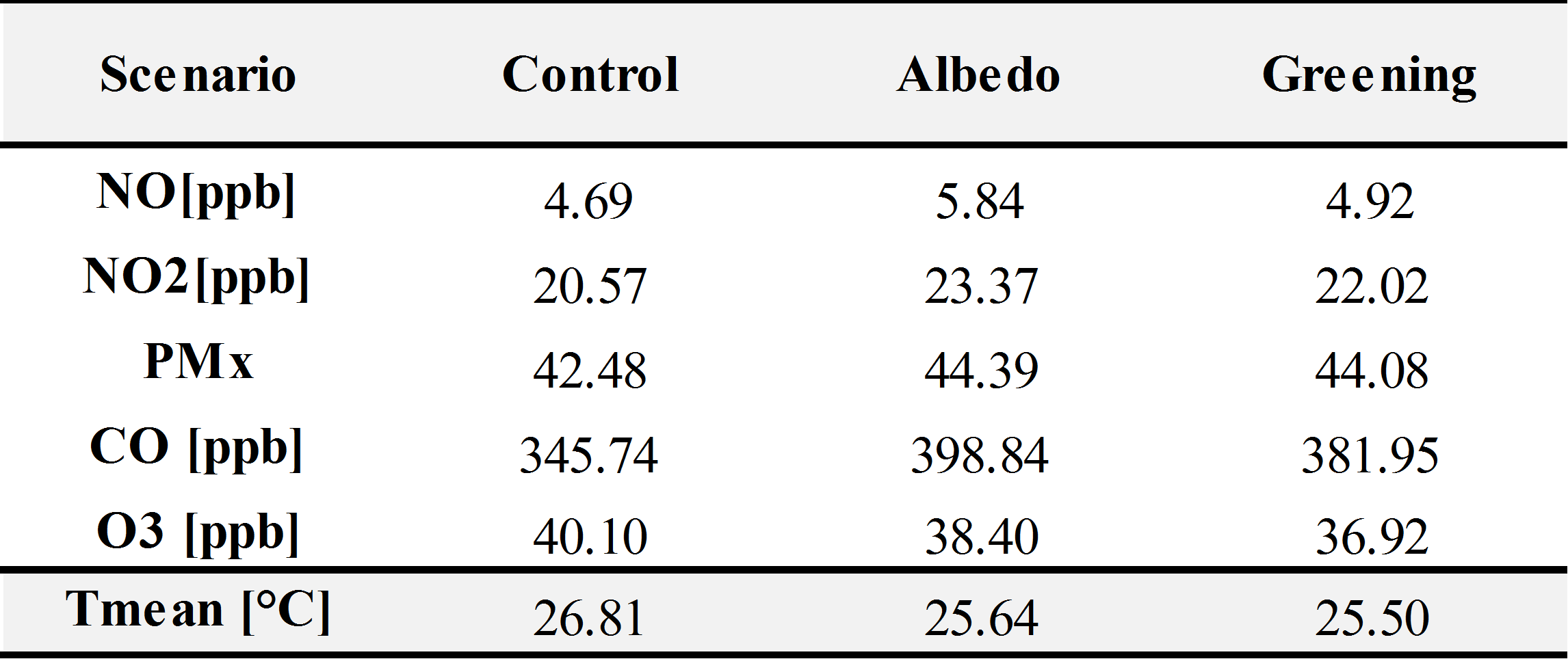
The effects of these mitigation strategies on chemical composition of the urban atmosphere are complex, attributed to both chemical and dynamical features. Increasing the reflectivity of roof surfaces in the model results in a net decrease of the surface ozone concentration, because ozone formation is highly correlated to temperature. With regard to primary pollutants, e.g. NO, CO and PM10 concentrations are increased when increasing reflectivity. This effect primarily can be ascribed to a reduction of turbulent motion, convection and a decrease of the boundary layer height, coming along with lower temperatures in the urban canopy layer due to increased reflectivity. The table below shows the effect on grid cell mean concentrations for different chemical species and scenarios.