Isotopic Content of Ground Ice in the Lower Kolyma River Valley (Eastern Siberia)
Abstract:
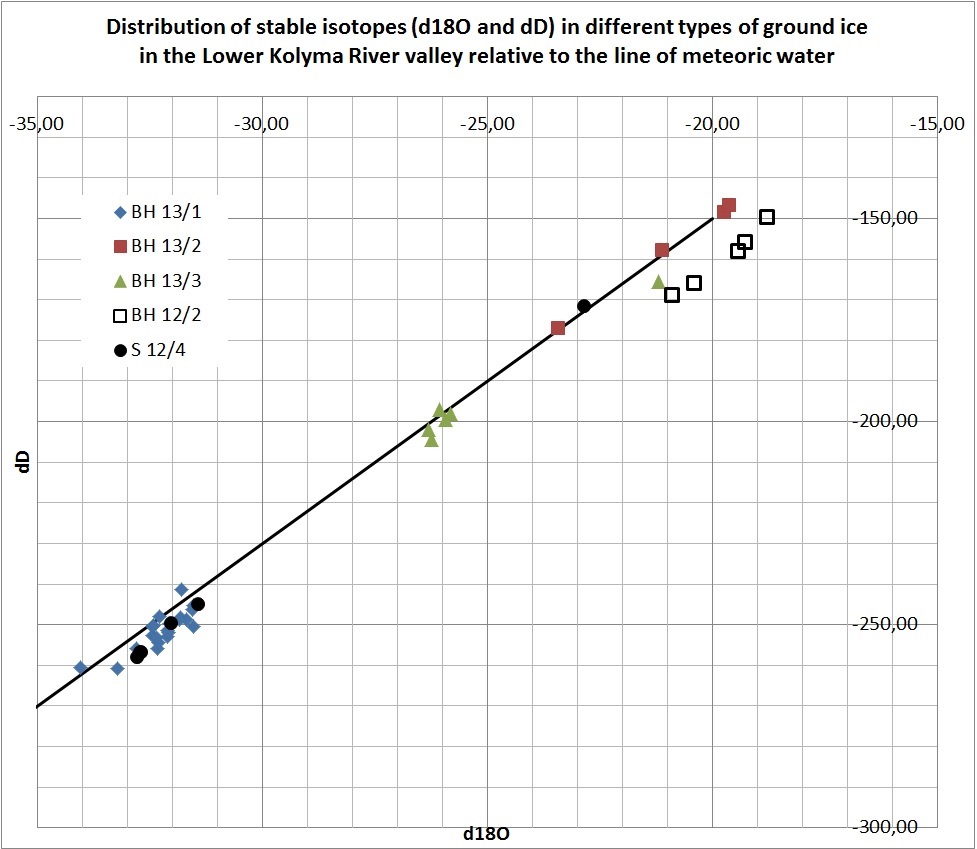
Late Pleistocene wedge ice (Ice complex) was recovered by the BH13/1 located on a yedoma relics towering over the low thermokarst plain (N68°30.7' E161°29.6') and S12/4 in the Duvanny Yar exposure (N68°37.8' E159°08.6'). Isotopes δ18O and δD range from -31.413 to -34.05 and from -244.934 to -260.57, correspondingly.
Modern wedge ice was recovered by the BH13/3 located on the joint Kolyma and Panteleikha Rivers floodplain underlain by river-bed sediments (N68°36.8', E161°21'). Isotopes range from -25.83 to -26.32(δ18O) and from -197.09 to -204.47 (δD).
Oblique segregated ice layers adjacent to a modern ice wedge were recovered by the BH12/2 on the annually flooded thermokarst plain (N68˚30.8' E161˚30). Isotopes range from -18.778 to -20.897 (δ18O) and from -149.883 to -168.901 (δD). The δD contents are the lowest here, resulting possibly from mixed (ice wedging and segregation) mechanism of ice lenses formation.
Segregated ice was recovered by the BH13/2 on the Schuch’e lake alas (N68°44.77', E161°23.3') and S12/4 in the transition layer of the Duvanny Yar. Isotopes range from -19.63 to -23.43 (δ18O) and from -146.77 to -177.23 (δD).
Preliminary results are as follows: 1) all samples are distributed near the line of meteoric water providing evidence for atmospheric origin of ground ice in the region; 2) isotope distribution exhibits a clear distinction between Late Pleistocene wedge ice, modern wedge ice, segregated ice adjacent to a modern ice wedge, and segregated ice; 3) the excess shows evidence of far remoteness of the region from the sources of atmospheric moisture; 4) mean annual air temperatures reconstructed by δ18O constitute, on average, ca. -26°C for the Late Pleistocene wedge ice, -10°C for modern wedge ice, and, with certain reservation, -9° C for segregated ice.