Elements at Risk Exposed to Landslides in the Eastern European Alps
Abstract:
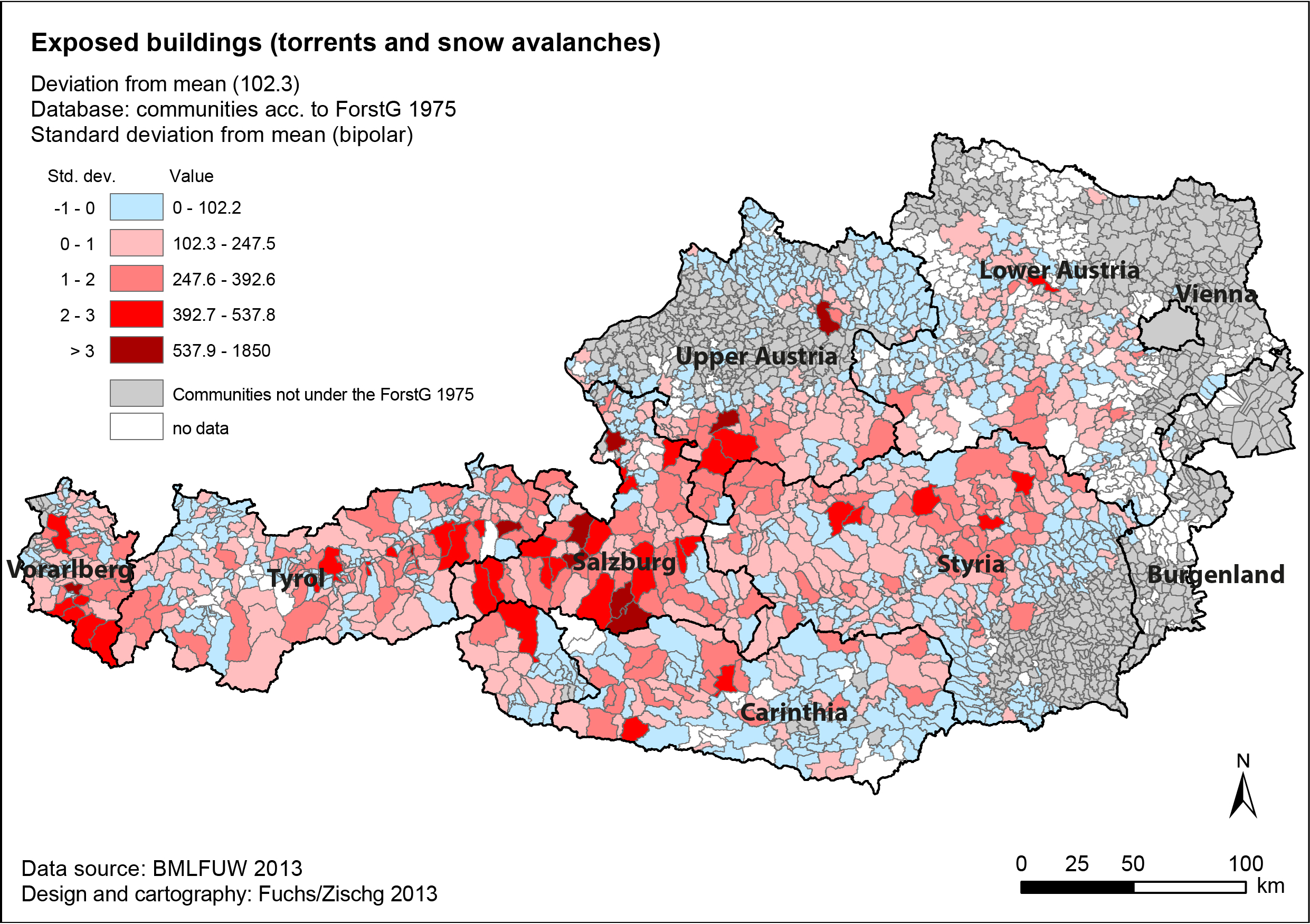
The obtained results were analysed according to different parameters. In Fig. 1 the results are shown for every community, and clearly indicate that there is a considerable amount of people and residents potentially threatened by landslide hazards. Around 2.45 million buildings exist in Austria, 123,040 of which are exposed to red and yellow hazard zones (torrents: 113,876; snow avalanches: 9,164). Subtracting those buildings which are exposed to both torrents and snow avalanches, approximately 120,400 buildings remain (around 5 % of the building stock) with an overall value of € 67.25 billion (torrents: € 61.14 billion; snow avalanches: € 6.11 billion). In sum, around 430,000 people are exposed in these buildings (torrents: 399,253; snow avalanches: 30,158). Taking an overall population of 8.44 million this equals around 5 % of the residents.
If queried spatially on a municipal level, considerable differences were manifest throughout the country. In the Federal State of Salzburg around 17 % and in Tyrol 15 % of all buildings are exposed to torrents and snow avalanches, whereas in Vienna, Burgenland and Lower Austria this value is considerably smaller.
Our analysis provides the basis for further analysis on the regional and local level. A nation-wide assessment of vulnerability to landslide hazards (including snow avalanches) provides insight in disaster hot spots and is essential for landslide risk management.
Fuchs, S.; Keiler, M.; Sokratov, S. & A. Shnyparkov (2013): Spatiotemporal dynamics: the need for an innovative approach in mountain hazard risk management. Natural Hazards 68 (3). p. 1217-1241