Burden Sharing with Climate Change Impacts
Abstract:
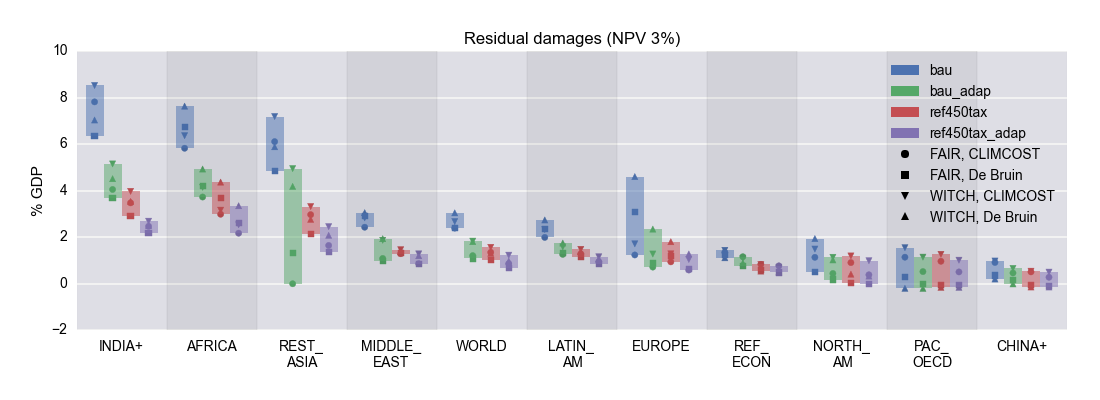
In this paper we use two integrated assessment models -FAIR and WITCH- to explore the 2°C policy space when accounting for climate change impacts. Impacts are represented via two different reduced forms equations, which despite their simplicity allows us exploring the key sensitivities- Our results show that in a 2 degree stabilization scenarios residual damages remain significant (see Figure 1) and that if you would like to compensate those as part of an equal effort scheme – this would lead to a different allocation than focusing on a mitigation based perspective only. The residual damages and adaptation costs are not equally distributed – and while we do not cover the full uncertainty space – with 2 different models and 2 sets of damage curves we are still able to show quite similar results in terms of vulnerable regions and the relative position of the different scenarios. Therefore, accounting for the residual damages and the associated adaptation costs on top of the mitigation burden increases and redistributes the full burden of total climate change.