The Eastern Black sea rifting and inversion: insights on the tectonic evolution of Crimea according to new stratigraphic data
The Eastern Black sea rifting and inversion: insights on the tectonic evolution of Crimea according to new stratigraphic data
Previously Published Material: Partly these results were presented on Final Symposium of DARIUS meeting 8-9 December, 2014, Paris
Abstract ID#: 34388
English Abstract:
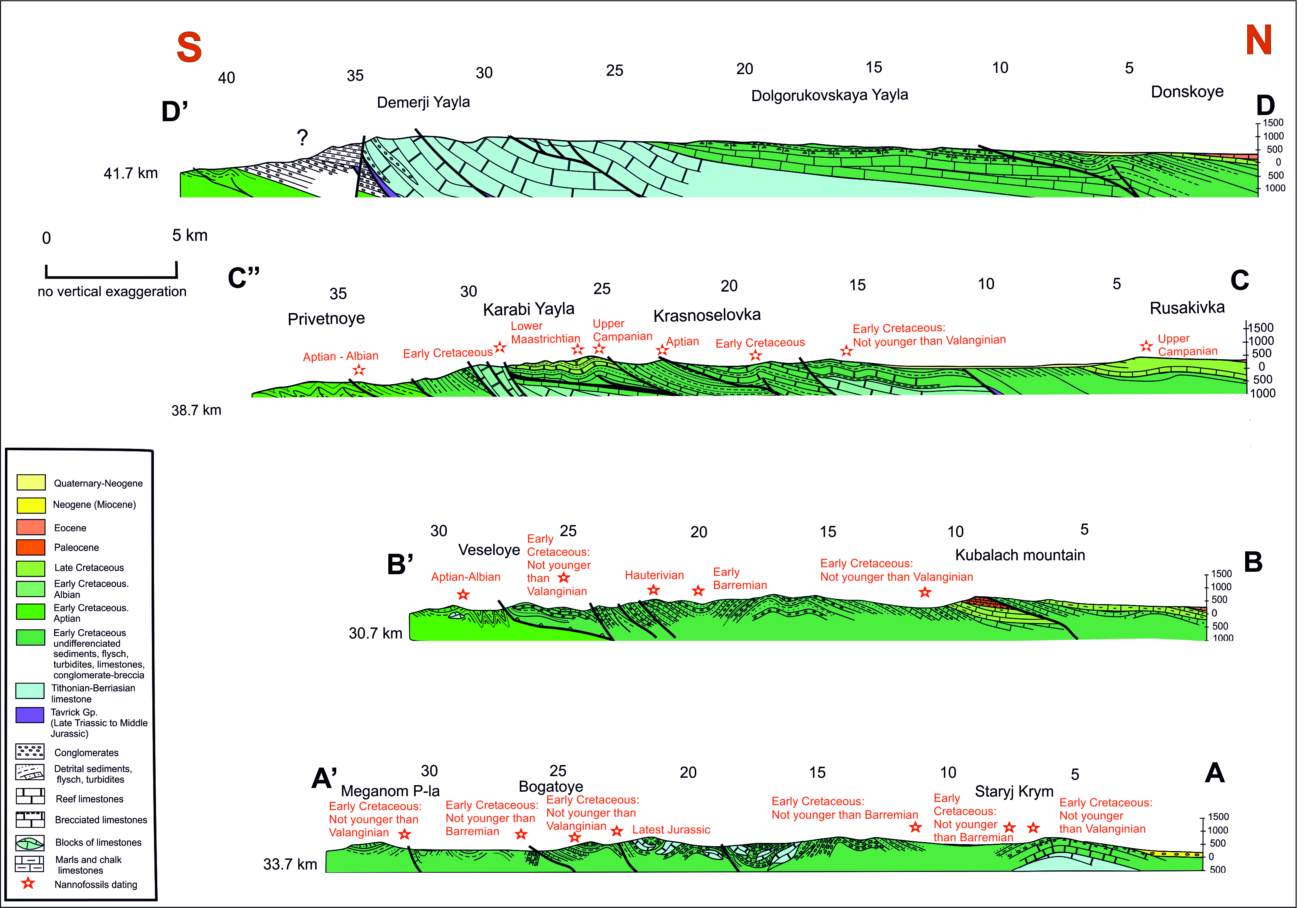
The tectonic evolution of the Eastern Black Sea basin was deciphered according to offshore and on land data, some from Crimea (Robinson et al., 1996; Nikishin et al., 2003, 2014; Saintot et al., 2006; Yudin, 2009; Stovba et al., 2009; Stephenson & Schellart, 2010; Meijers et al., 2010; Popadiuk, et al., 2011, 2013; Okay et al., 2013, Stovba et al., 2013). But there, recently, the changes in stratigraphy have been occurred: the Tavrick Group (TG) of Late Triassic-Early Jurassic ages (Muratov, 1960, Okay & Nikishin, 2012) was declared as younger: Aptian-Albian (Popadyuk et al., 2011, 2013). In order to clarify the stratigraphy and the tectonic evolution of this area we sampled (more than 300 samples) the Eastern Crimea Mountain for the micropaleontological dating (Nannofossils assemblages). The results determined the age of Early Cretaceous and significantly rejuvenate the age of TG as well as the age of flysh-type sediments previously defined as Late and Middle Jurassic (Sheremet et al., 2014). Our new dating indicates that Lower Cretaceous formations widely spread in the Eastern Mountain Crimea, characterized by turbidites, conglomerates and olistostromes. The samples contain a lot of volcanic ashes, which suggests that the deposition is synchronized to a period of strong magmatic activity all along the Eastern Crimea (Meijers et al., 2010; Nikishin et al., 2013). Our field observations allow proposing a new structural map on this region and cross sections. The period of extension during the Early Cretaceous and of compression during the Late Cretaceous-Paleocene at least before the main unconformity of the Middle Eocene limestone were defined. These two periods are in relation with: 1) the opening of the East Black Sea basin, along N-NW S-SE trending normal faults, with magmatic events; 2) N-S shortening due to the beginning of the collision southward in Pontides and Taurides with transferring the deformations to the north, in Crimea peninsula.